#reading
 vocabulary
One Word, Many Voices: How 'Death' Changes Across Twenty-Five Centuries
Follow the word 'death' from Aesop and Boethius to Austen, Dickens and beyond: one plain word remade by twenty-five centuries of writers.
 vocabulary
Disaster Literally Means 'Bad Star': The Astrology Hidden in Everyday English
Disaster once meant 'a bad star,' a lunatic is moonstruck, and influence flowed from the heavens: everyday English still carries the old astrology.
 vocabulary
Glamour Is Literally the Word 'Grammar': From a Spell to Dazzling Charm
Glamour and grammar are the same word. It began as a Scots term for magic, a spell that deceives the eye, long before it ever meant dazzling charm.
 vocabulary
One Word, Many Voices: How 'Time' Changes Across Fourteen Centuries
Follow the word 'time' from Boethius in the sixth century to Jane Austen and beyond: one plain, everyday word remade by every age of English writing.
 vocabulary
Is Pride and Prejudice Hard to Read? It's the Sentences, Not the Words
Pride and Prejudice isn't hard because of its words — you'll recognise about 97 in every 100. The difficulty is Austen's long sentences and her irony.
 guides
How to Practise Reading Comprehension with the Classics
Knowing every word isn't the same as understanding the page. How to practise reading comprehension with the classics — and check you actually followed it.
 guides
One Text, Every Level: Teaching a Mixed-Ability Reading Class
A mixed-ability class doesn't need different books — it needs different tasks. How to differentiate one shared reading by support and challenge.
 guides
The Hidden Order of Adjectives: Why It's a 'Big Red Ball,' Not a 'Red Big Ball'
English sorts stacked adjectives by a strict unwritten rule: opinion, size, age, shape, colour. You follow it perfectly, and were never taught it.
 vocabulary
Is Dracula Hard to Read? What Actually Makes It Difficult
Dracula reads easier than its reputation suggests. The real difficulty is its dialect voices and its diary structure, not its vocabulary.
 guides
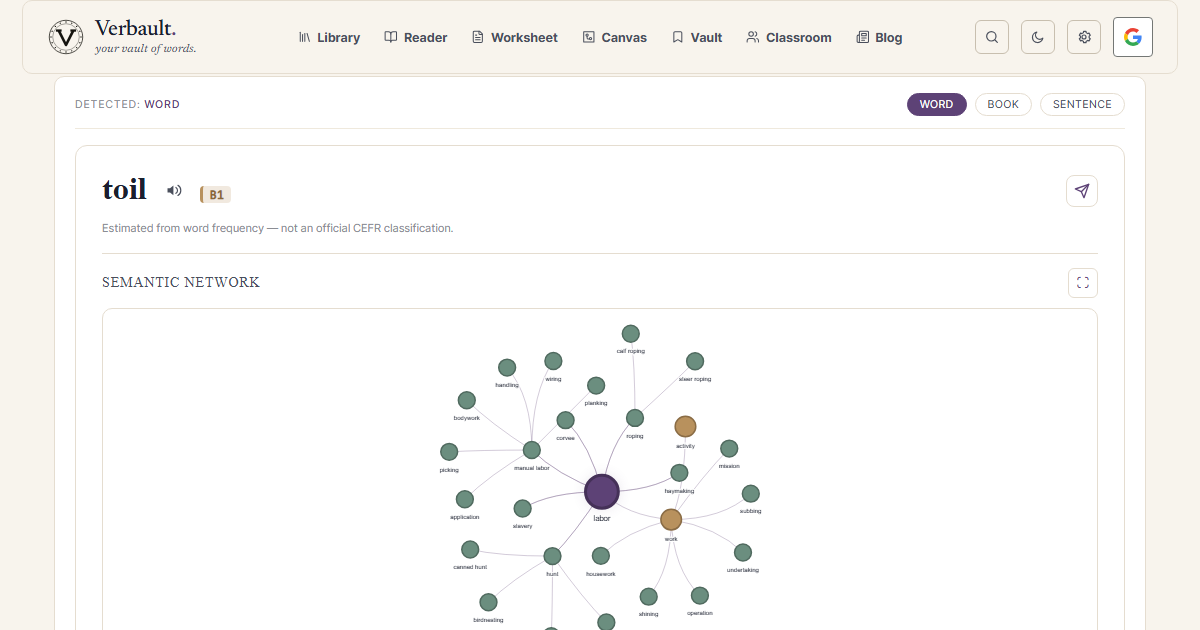
When to Look Up a Word — and When to Keep Reading
Looking up every unfamiliar word kills the story; looking up none leaves you lost. A simple rule for deciding which words actually need a definition.
 guides
Where to Start with the Classics: Why Difficulty Isn't One Number
A classic's difficulty is two things: how rare its words are and how long its sentences run. Here's how to read both before you open the book.
 guides
Word Order Is English Grammar: How Position Decides Meaning
English barely changes its words, so it leans on word order to show who did what. Here's how position carries the grammar, and how to see it.