Glamour Is Literally the Word 'Grammar': From a Spell to Dazzling Charm
A word for beauty, hiding a word for school
Open the word page for glamour and Verbault files it near the top of the difficulty scale: reading level hard, CEFR C2. It is the word we keep for things that dazzle — a film star, a city lit up at night, old Hollywood filmed like a dream. All surface, all shine.
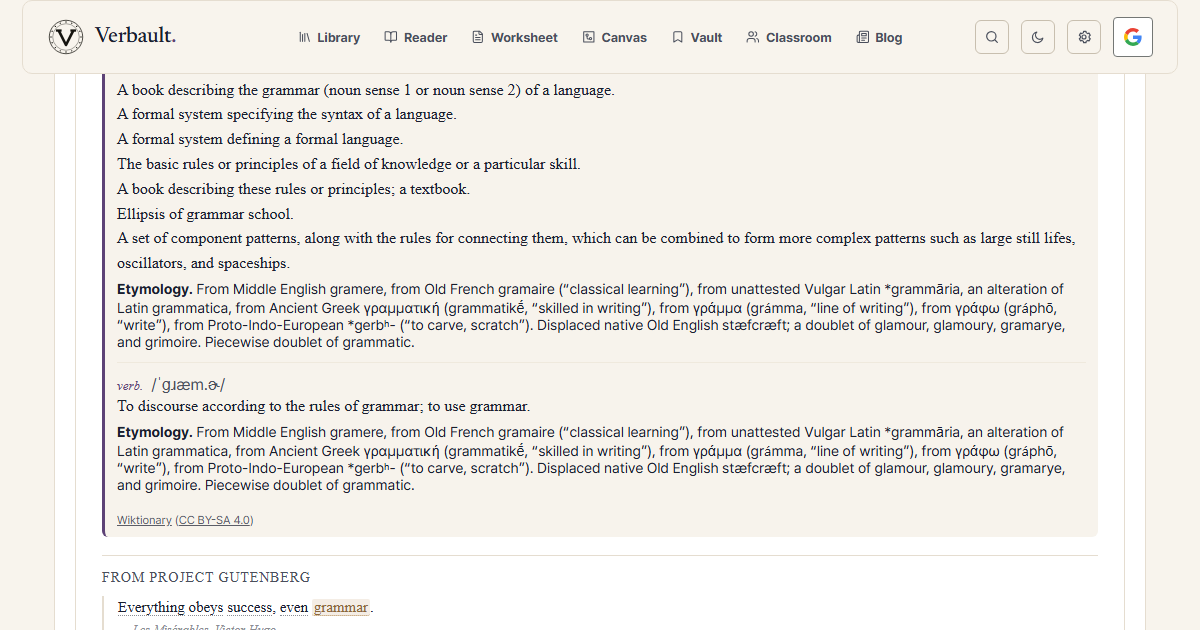
Now say it slowly and listen for the plainer word sitting inside it. Glamour is grammar. Not a pun, not a chance rhyme: the same word, worn smooth and handed between languages until the sparkle it now carries has nothing obvious to do with a classroom. The grammar page says so in one line at the end of its origin. Grammar, it notes, is a doublet of glamour — two English words grown from a single root.
This post follows that root from a Greek letter to a red carpet, using the origins printed on Verbault's own word pages.
From Scots magic to English charm
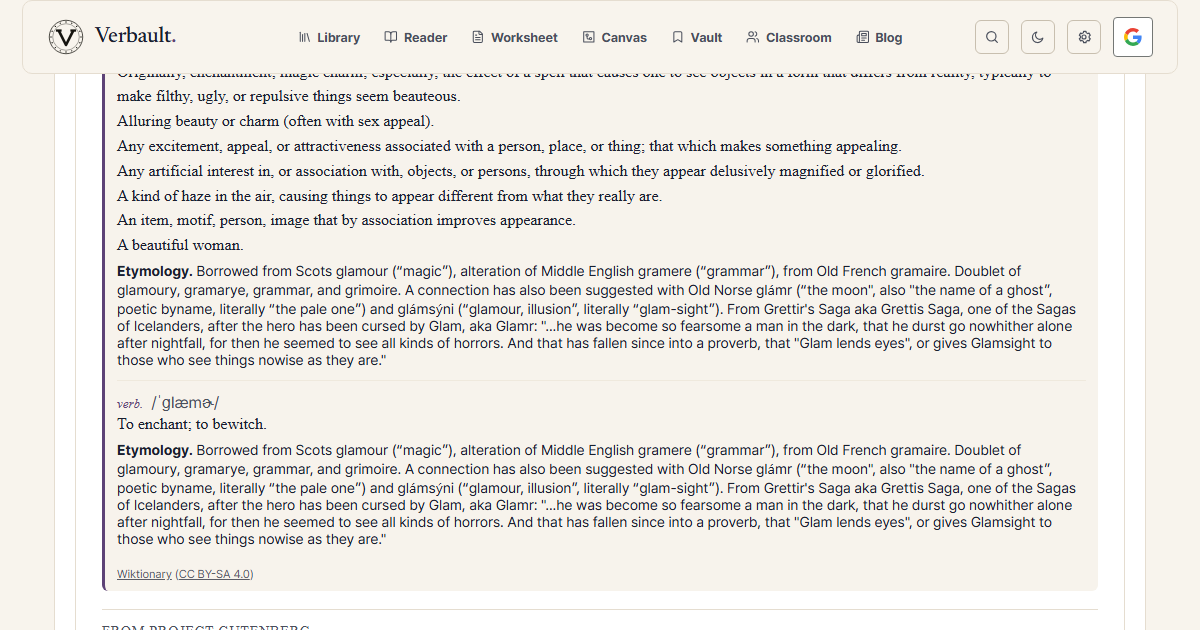
glamour reached standard English only in the eighteenth century, borrowed from Scots, where it did not mean beauty at all. It meant magic — and a particular kind, the sort that fools the eye. A glamour was a spell laid over you so that you saw something that was not really there: a hovel as a palace, a stranger as someone you loved.
The Scots had reshaped it from Middle English gramere, their own pronunciation of grammar. And grammar had come in turn through Old French gramaire, from Latin grammatica, from Greek grammatikḗ, "the art of letters." At the very bottom sits the Greek grámma, which meant simply a letter, a thing written.
So the chain runs from a letter to the study of letters to magic to dazzling beauty. The strange link is the third one. Why would a word for grammar ever come to mean a spell?
When learning was itself a kind of magic
The answer is that, for most of the Middle Ages, book-learning and the occult were not kept neatly apart. Very few people could read. To the many who could not, a figure bent over a page, murmuring in Latin over marks that meant nothing to them, looked a great deal like someone working a charm. Learning was mysterious, and mystery slides easily into magic.
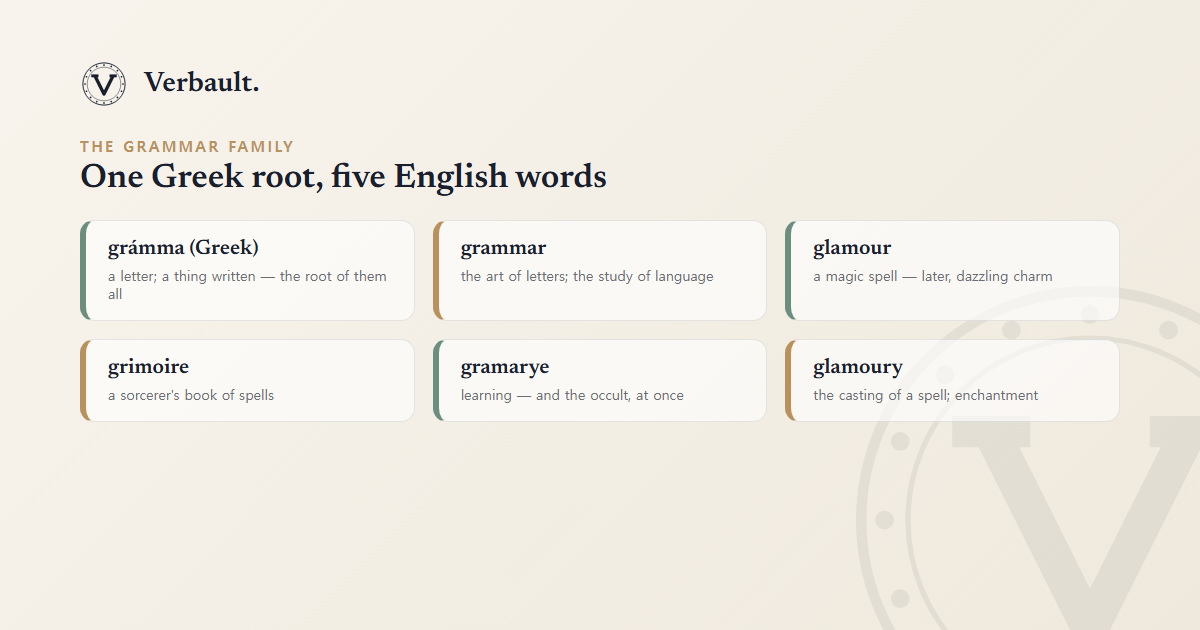
You can watch the two meanings travel together in a small family of words, every one of them the same word as grammar underneath:
- grimoire — a sorcerer's book of spells. Its own origin traces it to Old French gramaire, glossed there as "grammar; grimoire; conjurer, magician" — three senses sharing one word.
- gramarye — an old word that meant both plain learning and the occult, with no seam between them.
- glamoury — the casting of a spell; enchantment itself.
For a long stretch the word for study and the word for sorcery were the same word. Grammar kept the respectable half and became the thing you were taught at school. Glamour and grimoire kept the other half and walked off into magic.
How a spell became a compliment
Glamour stayed close to magic well into the nineteenth century. The Scottish poet and novelist Walter Scott did more than anyone to carry the word into wider English, and in his notes to The Lay of the Last Minstrel (1805) it still means pure enchantment. Glamour, he explains, is "the magic power of imposing on the eye-sight of spectators, so that the appearance of an object shall be totally different from the reality." A glamour was an illusion laid over the truth.
From there the modern sense is a short step. If a glamour is a flattering illusion, a surface laid over a plainer reality to make it look better than it is, then it takes very little to start calling the surface itself glamour. By the early twentieth century, with fashion magazines and the film studios hungry for exactly that word, glamour meant alluring charm, and the spell had quietly slipped out of view.
Not completely, though. The old meaning still leaves a mark. When we call something glamorous we usually mean it dazzles on the surface, and we half-suspect the surface is doing some of the work — that the reality behind it is more ordinary. That faint sense of illusion is the old spell, still at its trade. Verbault even keeps the magic on the record: on the glamour page, one of the listed senses is a verb. To glamour someone is to cast a spell over them. The enchantment never really left the word; it only moved to a quieter room.
See the origin for yourself
You do not have to take any of this on trust. Every claim above is printed on a word page you can open right now, and tracing a doublet like this takes a couple of minutes.
Follow the trail in three steps
- Start on the word page. Open glamour. Near the top you get its reading level and meaning; scroll down to the origin and you reach the line that starts it all — Scots glamour ("magic"), alteration of Middle English gramere ("grammar").
- Cross-check from the other side. Open grammar in a second tab and read to the end of its origin. It names its own twins in plain sight: a doublet of glamour, glamoury, gramarye, and grimoire. When two separate word pages point back at each other like this, you are looking at one word that split in two.
- Meet the dark cousin. Open grimoire, the sorcerer's spellbook. Its origin reads Old French gramaire — "grammar; grimoire; conjurer, magician" — the clearest single snapshot of the moment when the word for learning and the word for magic were one word.
You can do the same with any word that catches your eye. Open a book in the Reader and tap a word: the meaning that fits the sentence comes up first, with the word's origin one tap below. Some of the plainest-looking words on the page have the strangest histories — and once in a while a word for beauty turns out to be a word for magic, which turns out to be a word for grammar.
Comments (0)
Log in to comment.