The Hidden Order of Adjectives: Why It's a 'Big Red Ball,' Not a 'Red Big Ball'
A rule you keep without knowing it
Say it out loud: a big red ball. Now try the other order, a red big ball. The second one is wrong, and you knew it was wrong before you could say why. Nobody ever taught you to put big in front of red. There is no lesson for it in any schoolbook you were handed. Yet you have never once said it backwards, and neither has anyone you have ever spoken to.
English has a fixed order for adjectives stacked in front of a noun, and almost no native speaker can recite it. We just obey it, every day, the way we keep a walking rhythm without counting our steps.
The order you already obey
When several adjectives pile up, they sort themselves by category, and the categories run in a set sequence: opinion, size, age, shape, colour, origin, material, purpose, and then the noun.
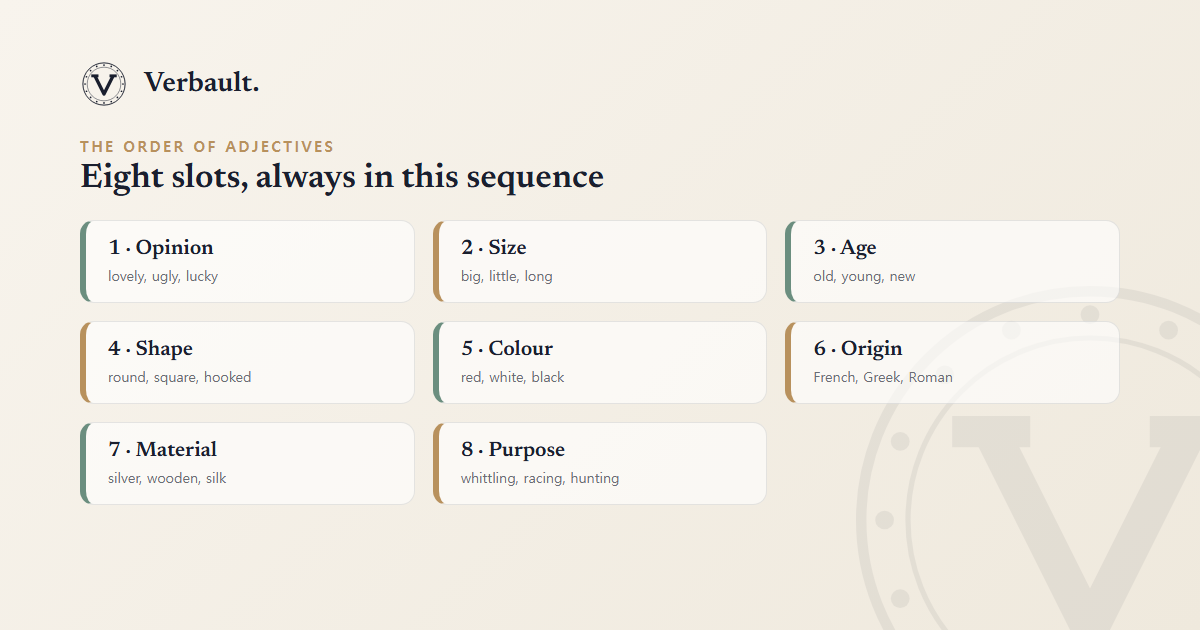
So opinion comes before size (a lovely little cottage, never a little lovely cottage); size before colour (a big red ball); colour before origin (a black Italian coat), and on down the line. The writer Mark Forsyth gave the rule its most quoted demonstration in The Elements of Eloquence: you can speak of "a lovely little old rectangular green French silver whittling knife," he notes, but swap any pair out of order and "you'll sound like a maniac." It is true. A green French old knife is unbearable, and you cannot name the law it breaks.
That is eight adjectives in a row, each from a different slot, and their order is not a matter of taste. It is closer to grammar than to style.
Why you can't feel the rule you use
The order is invisible because you learned it the way you learned to walk: by doing, far too early to remember. A small child hears thousands of little red wagons and big bad dogs and takes in the pattern whole, years before anyone says the word adjective. By the time the rule could be taught, you had no use for the lesson.
People learning English later are the ones who feel its weight, because they often meet the words before the music. They know red, big, and ball, and nothing inside those three words says which goes first. The order has to be learned again, slot by slot. That is the clearest proof that a rule is there at all: a thing you must teach a newcomer is a thing the rest of us are quietly running.
The great authors obey it too
Because the order sits below the level of choice, you can open almost any book and watch a careful writer keep to it without comment. The classics in Verbault's library are thick with stacked adjectives, and they fall into line exactly as the rule predicts.
Melville writes of "the great White Whale" — size, then colour. Conrad, in Heart of Darkness, watches "a little white smoke" vanish from a ship's gun: size, then colour again. Chekhov, sketching a man in "The Lady with the Dog," gives him "a long hooked nose" and "a big black beard" — size before shape, size before colour, each word dropping where its category belongs. None of these writers stopped to arrange their adjectives. The order was already in the ear, theirs and yours alike.
Run your eye down any page of description and you will not catch the rule broken. When an adjective does land out of its slot, it is almost always doing something deliberate, and it registers precisely because the ordinary order is so dependable that a break stands out.
Where the rule bends
Like most things in a living language, the order has a firm centre and a soft edge.
The famous exception is the Big Bad Wolf. By the rule, bad is an opinion and big is a size, so opinion should lead: the bad big wolf. No one says that. Here an older instinct takes over. Linguists call it ablaut reduplication: the rule behind tick-tock rather than tock-tick, and King Kong rather than Kong King, in which certain vowel sounds simply prefer to come in a fixed order. When that musical habit and the adjective rule disagree, the music often wins.
The categories blur at their edges, too. Is great a size or an opinion? In a great big house it works as one more size word; in a great novelist it is pure opinion. The slots are real, but they are not sealed boxes, and a handful of words drift between them depending on the job they are doing. The reference books even disagree a little among themselves about the exact run of slots, with some placing shape ahead of age; that is itself a fair sign the sequence is a strong habit, not a single iron law. That give is normal. It is the same softness you find in words that mean their own opposite: a clear rule at the core, fraying gently at the rim.
Reading with the rule in your ear
You do not have to memorise the eight slots to use them, since you already have them. But noticing the rule changes how description reads. Once you can hear the order, you can also hear a writer lean on it, stringing adjectives together because each one drops into place without friction.
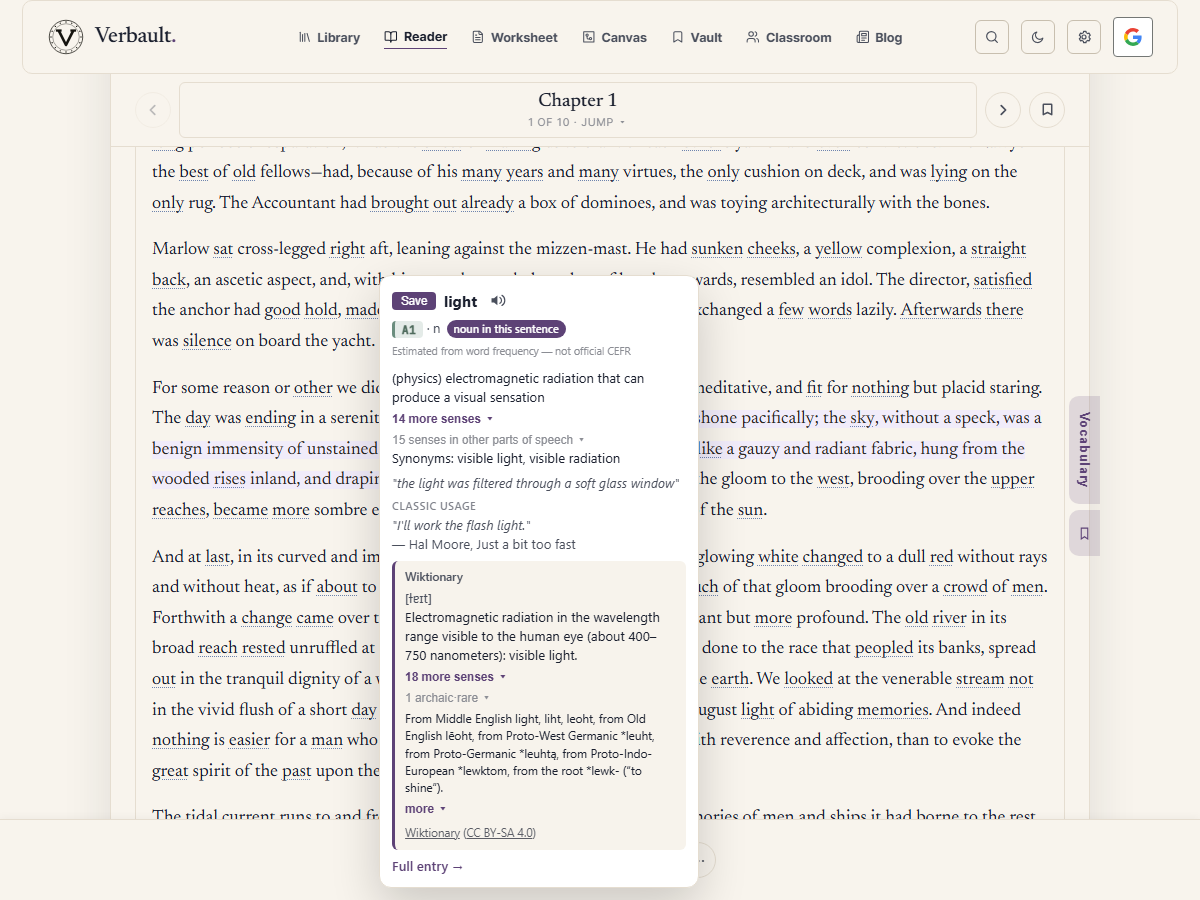
The Reader is a good place to watch it happen. Open any classic and the description is in front of you, every word tappable. When you reach a stacked phrase, tap the adjectives one by one: Verbault shows the sense that fits this sentence, so you can feel how great is doing size work in one line and opinion work in the next.
The rule has two close relatives we have written about. It is the adjective-sized version of word order is English grammar, where a word's position alone decides its job; and choosing which adjective to stack, slim or skinny, old or ancient, is the craft we took up in choosing between near-synonyms. The order tells you where each word goes. The other two tell you which word to put there.
The machine you never knew you ran
The quiet pleasure of the adjective rule is catching your own mind at work. You have been sorting words into eight invisible slots your whole life, at the speed of speech, without ever noticing. Getting a big red ball right is a small thing. That you have never once got it wrong is the remarkable part.
Comments (0)
Log in to comment.