Where to Start with the Classics: Why Difficulty Isn't One Number
The classics have a reputation for being hard, and the reputation does real damage — it turns readers away from books they could in fact read. But "hard" hides a question almost nobody stops to ask: hard how? A book can be hard because it is studded with rare words you have to look up, or hard because its sentences run long and double back on themselves, or both at once. These are different problems with different cures, and the single word difficult smears them together.
Pull them apart and the question of what to read next gets much easier to answer. Verbault measures both, separately, for every book in its library, so you can tell what kind of hard a book is before you commit a week of evenings to it.
Two kinds of hard
The first kind is vocabulary: how often you turn a page and meet a word you simply don't know. The second is sentence complexity: how long and how knotted the sentences are, quite apart from whether you know the words inside them. The two come uncoupled all the time. Plenty of beloved books are built from ordinary words arranged into sentences that wind on for half a page; a few are full of rare words set in short, clean lines. A book sits somewhere on each scale independently, and a reader who has only ever heard "the classics are hard" has no way to see which scale is the one giving them trouble.
How rare are the words?
The vocabulary scale is the one most people picture when they imagine a hard book, and it has a precise meaning: what share of the words on the page you already know. An earlier post on how many words you need to read a novel works through why that share — linguists call it coverage — is what really decides whether a book reads smoothly or fights you. The short version: when nearly every word is familiar, the occasional stranger is no trouble, because the sentence around it tells you what it means; when the strangers come thick, the guessing breaks down.
Verbault scores this for each book and labels it a Vocabulary level, from Beginner through Elementary, Intermediate, Upper-intermediate, Advanced, up to Proficient. The label is just a reading of how common the book's words are against ordinary English usage — a book lands at Elementary if a reader who knows the few thousand most frequent words can already cover most of its pages, and climbs from there as its vocabulary thins into rarer territory.
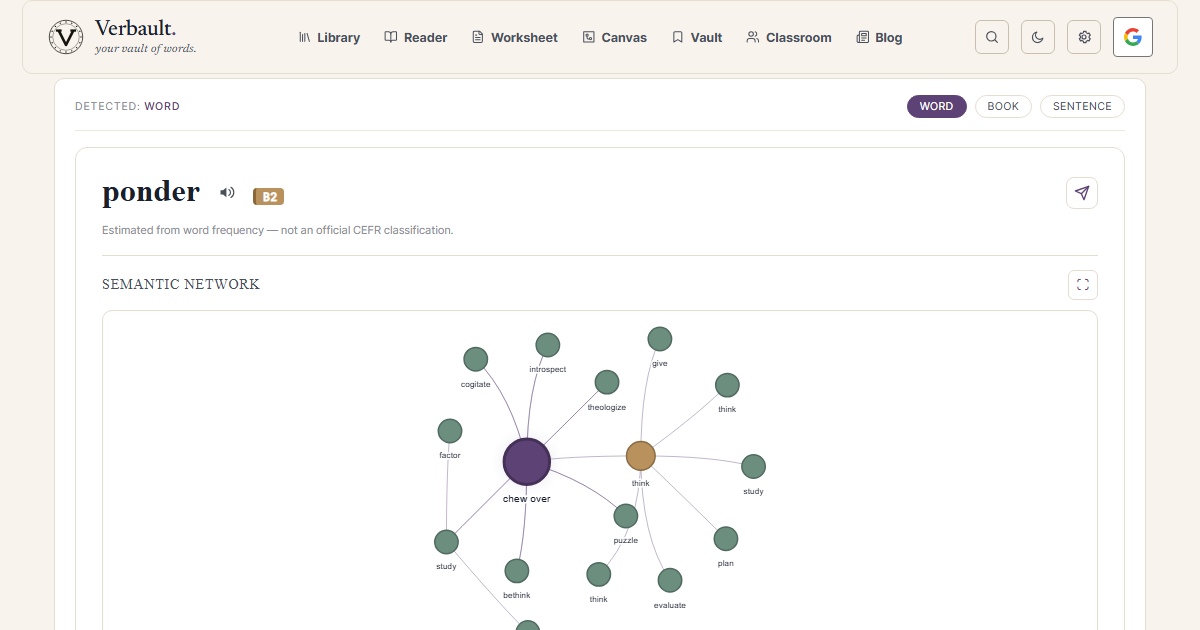
You can see what a single uncommon word looks like up close. Take ponder — a small step up from plain think, the kind of word a nineteenth-century novel reaches for without a second thought. Verbault marks it hard, and its page sets it at the centre of a web of nearer words — think over, meditate, contemplate, muse, reflect — that place it for you at a glance, so even a word you've never met is rarely a dead end. Meet one like that every few pages and a book reads easily; meet one every other line and it doesn't.
How long are the sentences?
Here is where the two scales pull apart, and where the famous-but-frightening books surprise you. Pride and Prejudice is the standing example of a "hard classic," yet its vocabulary is only Elementary — by word frequency, Austen writes with a plainer palette than her reputation suggests. What actually makes her demanding is the other scale entirely. Her sentences are long, balanced, and full of subordinate clauses, and Verbault's sentence measure — the Flesch–Kincaid grade — puts them at grade 12. The words are easy; the sentences are not. What Verbault's two measures tell you, read together, is exactly what you are signing up for: not a glossary problem but a patience-and-syntax one.
The pattern repeats once you look for it. Grimms' Fairy Tales sits at Beginner vocabulary — these are children's stories, after all — but the old translated prose still earns a grade-12 sentence score. Don Quixote keeps its words ordinary while its sentences run so long they post a Flesch–Kincaid grade close to nineteen — well past anything school asked of you. And it runs the other way too: Oscar Wilde's The Picture of Dorian Gray draws on an Elementary vocabulary set in unusually short, clean sentences — a grade around six — so a book that sounds forbidding turns out to be one of the smoother reads on the shelf.
These sentence grades come with a caveat, and an honest guide names it. Flesch–Kincaid was built for ordinary prose and it stumbles on anything else. Verse fools it: Romeo and Juliet scores a gentle grade five — not because Shakespeare is simple, but because a line of verse is short, and the formula reads a short line as an easy sentence. Stream-of-consciousness fools it the same way: Ulysses, one of the hardest books in the language, posts a single-digit grade because its run-on interior monologue gives the measure almost no full stops to work with. Read the sentence grade as a rough signal for normal narrative prose, not a verdict — and when verse or experiment is involved, trust your own eyes over the number.
A rough ladder, in two dimensions
Put the two scales together and you don't get a single ranking of books — you get a grid. A book can sit low on words and high on sentences, or the reverse, and where you start depends on which kind of difficulty you'd rather take on first.
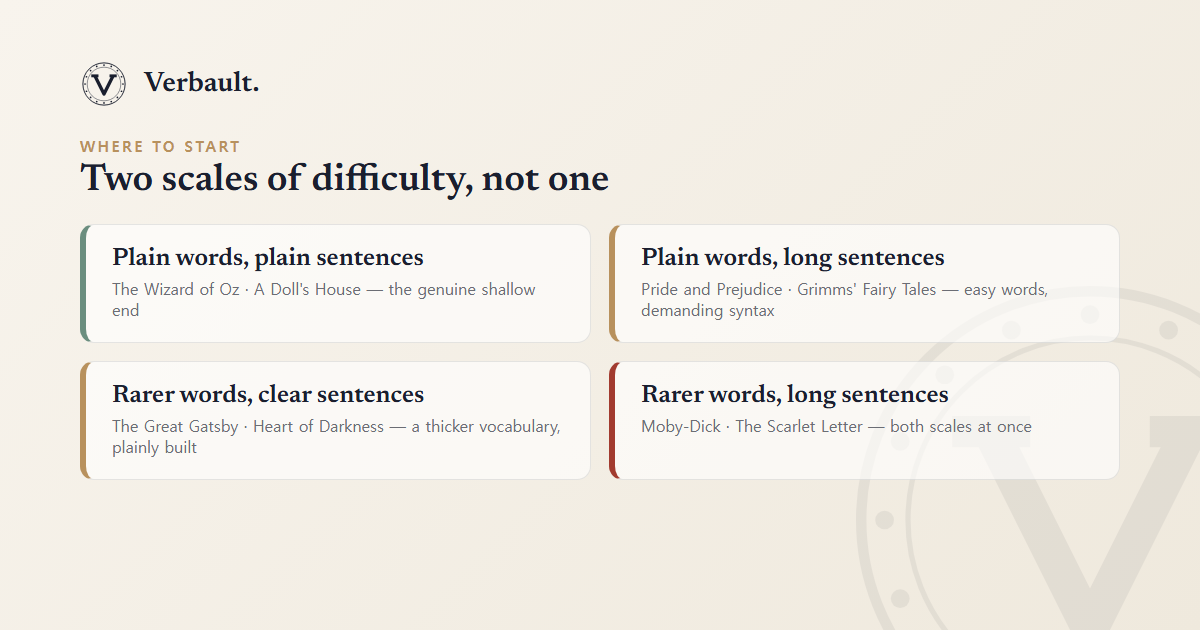
If you want the genuine shallow end, look for plain words and plain sentences: The Wonderful Wizard of Oz and, if a play suits you, Ibsen's A Doll's House, whose spoken lines keep both scales low. To stretch your patience while keeping the vocabulary easy, take on the long-sentence classics — Pride and Prejudice, the Grimms. To stretch your vocabulary while the prose stays clean and modern, The Great Gatsby and Heart of Darkness sit at Intermediate words in short, plain sentences. And the books that press on both at once — Moby-Dick at Upper-intermediate with grade-11 sentences, Hawthorne's The Scarlet Letter close behind — are the ones to climb toward, not to open cold.
Reading a book's level in Verbault
Verbault computes both scales — the vocabulary level and the Flesch–Kincaid sentence grade — for every book in its library. You don't have to take either on faith, and putting them to work comes down to two moves.
- Filter the library by level. At the top of the library there is a reading-level menu running from Beginner to Proficient. Pick a level and the shelf narrows to books whose vocabulary is pitched there. If you're signed in, the Auto — my level option goes further: it reads the vocabulary you've built up from your own reading and shows you the books that sit at it, so the library quietly filters itself to where you actually are.
- Open a book in the Reader and read a paragraph. The surest test is the page itself. In the Reader, every word is quietly marked by how common it is, so the text shows you its own vocabulary difficulty as you read. If a paragraph comes up thick with hard marks, the book is above you for today; if only the odd word is flagged, you're home — let those few go, or tap any one to see its meaning and hear it spoken without leaving the page.
Both of those act on the vocabulary scale — the one you can see and respond to word by word. The sentence scale is quieter, because you can't tint a page with it; it lives in how a writer builds sentences across a whole book. But you rarely have to measure it on purpose. When a book's words are easy and the reading still feels like work, the sentences are the reason — and the move is the same either way: drop to a book that carries you, and climb back up. That is the lesson Austen teaches by being Elementary in her words and grade-12 in her clauses.
One honest note runs under all of it. The vocabulary level is estimated from how often each word turns up in ordinary English, not handed down by an exam board, and the sentence grade is a rough prose measure that verse and experiment can throw off. Treat both as a way to find the right shelf, not as a certificate — then let the reading itself confirm the fit.
So there is no single ladder of difficulty, because difficulty was never one thing. There is a vocabulary scale and a sentence scale, and a book can stand high on one while resting low on the other. The reader's task is not to brave the "hardest" books by reputation but to find the one where both scales sit close to where you are now — and then start there, and let each book carry you a little way up toward the next.
Comments (0)
Log in to comment.