Is Dracula Hard to Read? What Actually Makes It Difficult
A scary book that isn't a hard one
Dracula has the reputation of a difficult classic. It is Gothic, it is Victorian, it is well over a century old, and it is about a vampire. Everything about it promises heavy going. By the measurements that usually predict how hard a book is, though, it is fairly gentle. Verbault's readability analysis puts its sentences at around an eighth-grade reading level and its vocabulary in the middle band rather than the hard one. A reader who knows the common families of English words already recognises something like 97% of the words on a typical page.
That makes Dracula easier going than a genuinely hard classic such as Moby-Dick, where the rare words really do pile up. Difficulty has more than one axis — we sorted a shelf of classics along two of them in where to start with the classics — and on the vocabulary axis Bram Stoker sits comfortably in the middle.
So why does Dracula feel like work? Because the things that actually make it hard are things a vocabulary score cannot see.
It has no single narrator
Dracula is an epistolary novel: it has no narrator at all, only documents. The story is assembled out of private papers, and the book says so on its own first page.
"All needless matters have been eliminated, so that a history almost at variance with the possibilities of later-day belief may stand forth as simple fact."
What follows is a scrapbook. Jonathan Harker keeps a journal in shorthand. Mina writes letters and later types everything up. Dr. Seward dictates his diary onto a phonograph. Lucy writes her own letters; there are newspaper cuttings, telegrams, and the log of a doomed ship. Nobody hands you the plot. You assemble it yourself, the way the characters do, out of pieces written by people who each know only part of what is happening.
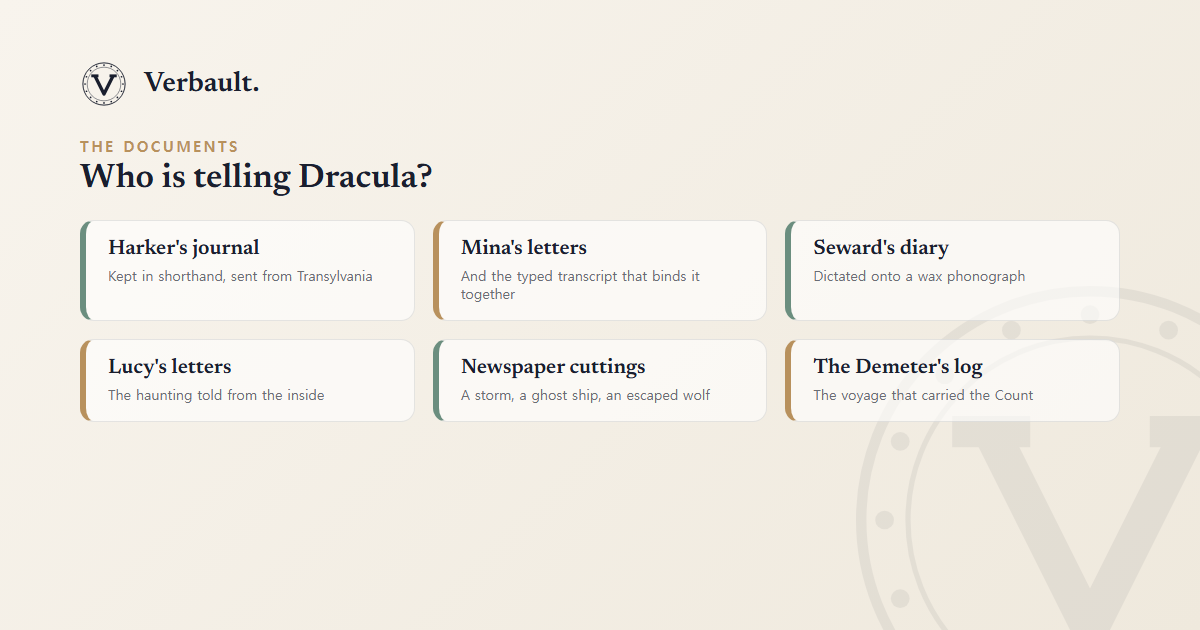
This is the quiet work Dracula asks of you: keep track of who is writing, when, and how much they have figured out. It is not hard vocabulary. It is bookkeeping.
It is written in voices
The pages that genuinely slow readers down are the ones in dialect, and the difficulty there is the opposite of a rare word. The words are plain; they are just spelled the way a particular mouth would say them.
In the Whitby chapters, Mina befriends an old Yorkshire fisherman named Mr. Swales, who talks like this:
"It be all fool-talk, lock, stock, and barrel; that's what it be, an' nowt else."
There is not a hard word in that sentence. Nowt is "nothing," an' is "and," and the grammar is broad Yorkshire. Read it aloud and it decodes itself — which is exactly the trick for every dialect passage in the book.
The other great voice is Professor Van Helsing, the Dutch doctor who drives the second half of the novel. He is learned, but English is not his first language, and Stoker writes his accent into the grammar:
"You have for many years trust me; you have believe me weeks past, when there be things so strange that you might have well doubt."
Again, every individual word is simple. What bends is the syntax: verbs that never take their endings (trust, believe), the flat there be. You are not reading unfamiliar words; you are reading familiar words in an unfamiliar order, and that turns out to be the harder thing.
It front-loads the strangeness
Dracula also puts its most demanding stretch first. Harker's opening journal is a travelogue through a corner of Europe few English readers of 1897 had seen, and the foreign place-names, foods, and customs arrive faster than the plot does. He records a peppery chicken "called 'paprika hendl,'" notes that it is "a national dish," and reminds himself, in the clipped style of a real diary, "(Mem., get recipe for Mina.)"
It is charming, but it is dense, and it comes before anything frightening has happened, which is part of why so many people stall on Dracula in the first thirty pages. Push through Transylvania and the prose opens out; the rest of the book moves far faster than its opening.
The few words the score does flag
In fairness, there is a thin seam of genuinely uncommon words running through the novel — overwrought, acrid, idolatrous and their kind, which Verbault's level badge marks as rare. But they are a garnish rather than the meal: a handful per chapter, each easy to handle on its own. Knowing which ones are worth stopping for is a small skill in itself, and we wrote about it in when to look up a word.
How to read it
Put together, the difficulties point to a way of reading that suits Dracula in particular.
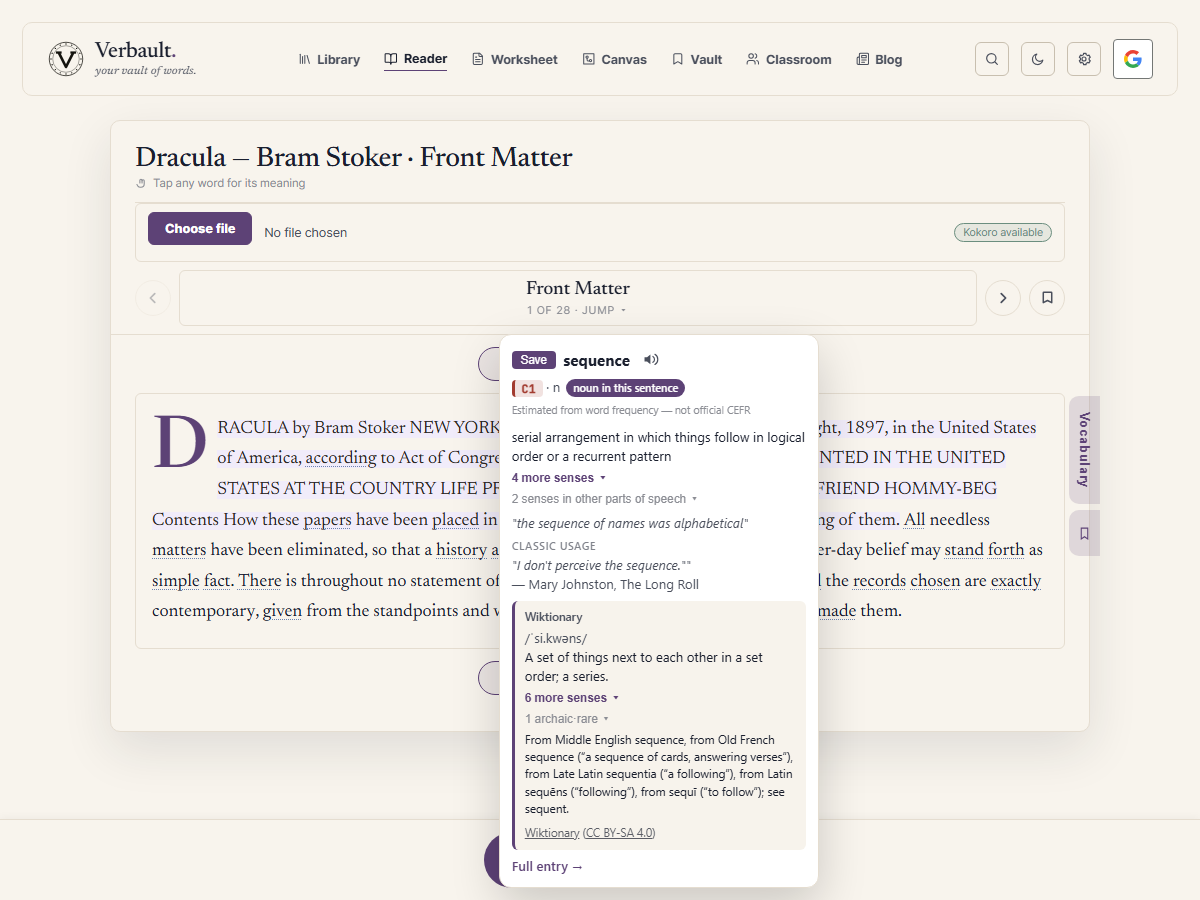
- Read it in the Reader. Open Dracula and the whole text loads with every word tappable. Tap one and a small card gives you the reading level, the meaning that fits this sentence, and a button to hear the line read aloud — so a rare word costs you a tap instead of a trip to a separate dictionary.
-
Read the dialect aloud. Swales and the Whitby fishermen are written phonetically, so your ear can decode what your eye trips over. The same goes for Van Helsing: hearing the line carries you past the bent grammar.
-
Keep track of who is writing. When a new document begins, note whose it is and where it sits in time. The structure is the story, and following it is most of the reading.
-
Get through Transylvania. Treat the opening travelogue as a threshold, not a wall. The book you were promised starts once Harker reaches the castle.
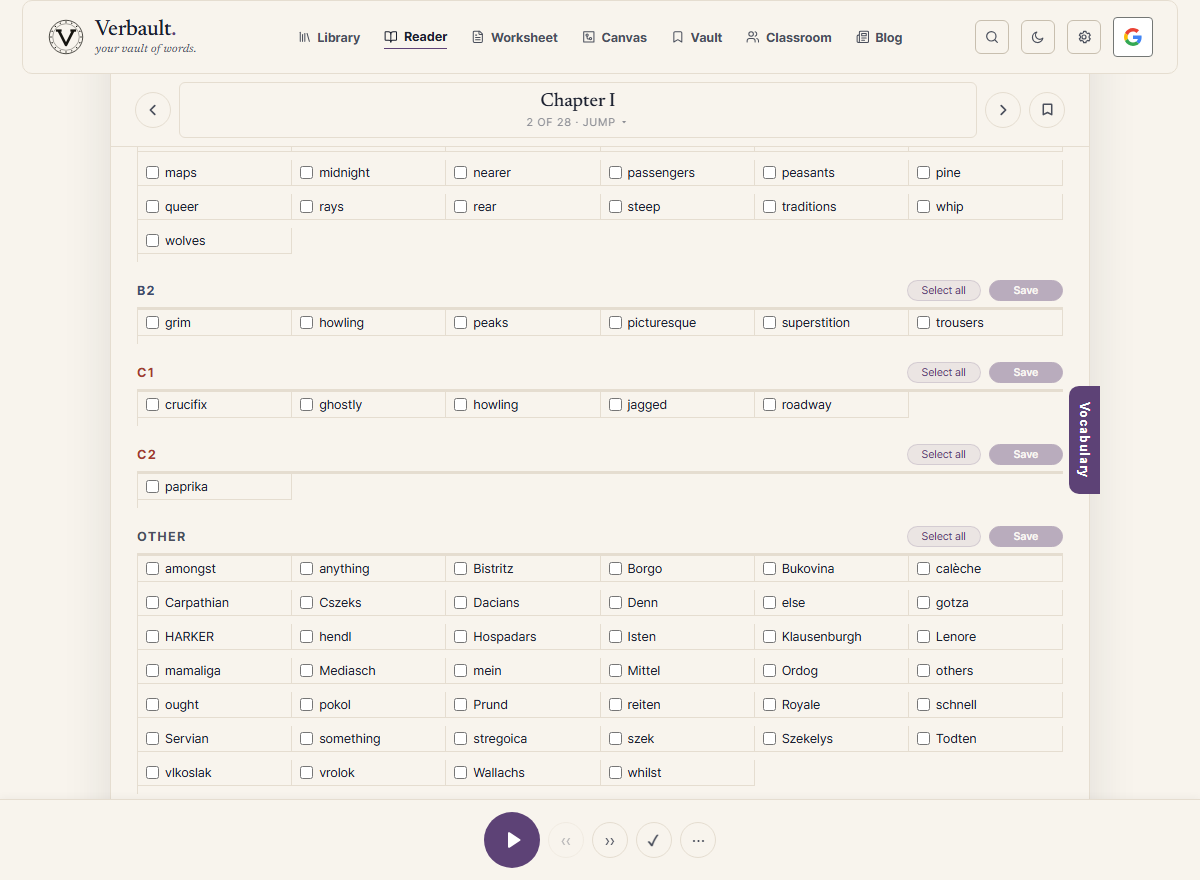
The Reader's Vocabulary tab makes the middle of all this easier to see. It gathers the words from whatever chapter you are reading and groups them by level, so you can confirm at a glance what the numbers say: that most of Dracula sits in the comfortable middle, with only a thin band of rare words worth keeping.
The hardness is the good part
Dracula is frightening on purpose and difficult by accident. Its difficulty is not a thick vocabulary but a chorus of voices and a story told in fragments — and once you can see that, the book gets a great deal easier to read. Better still, the voices that slowed you down turn out to be the best thing in it. Swales and his tombstones, Van Helsing and his broken, urgent English: that is not the obstacle in front of Dracula. It is the novel.
Comments (0)
Log in to comment.