Disaster Literally Means 'Bad Star': The Astrology Hidden in Everyday English
Disaster once meant "a bad star"
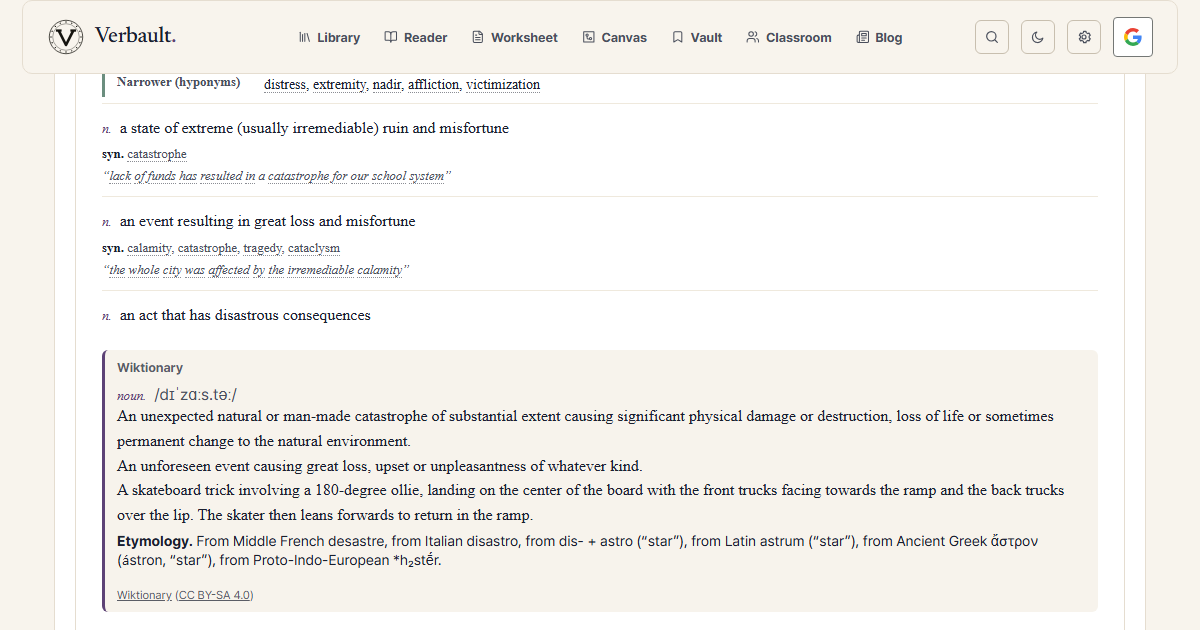
Open the word page for disaster and read down to the origin. The word reaches English through French and Italian, and at the bottom it comes apart into two pieces: dis-, a prefix of misfortune, and Italian astro, "star," from Latin astrum and Greek ástron. A disaster is, quite literally, an evil star — a moment when the heavens have turned against you.
That is not a metaphor a modern writer reached for. It is a fossil. The word was built at a time when people took it as plain fact that the stars and planets governed what happened on earth, and a run of bad luck was the visible work of a hostile sky. The belief has faded; the word kept its shape. Say disaster today and you are still, without meaning to, blaming the stars.
English is full of these fossils. Once you know the pattern, you start to notice how much of the old astrology is still lying around in ordinary words, hidden in plain sight.
When the stars ran everyone's life
For most of recorded history, astrology was not a hobby or a horoscope column. It was the working science of the day, taught in universities beside medicine and taken seriously by physicians, kings, and clergy. The heavens were thought to pour some kind of power down onto the world below, shaping weather, harvests, health, and character. A great deal of everyday vocabulary was minted inside that belief, and carries a trace of it still.
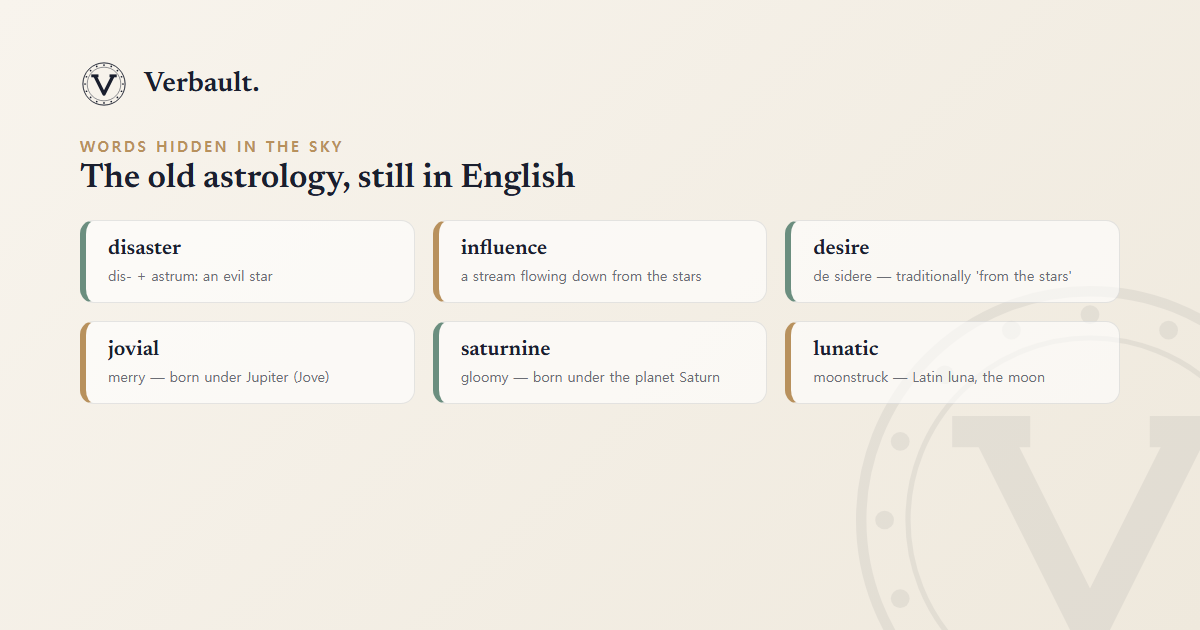
influence is the clearest case. Today it means the quiet power one person or thing has over another. Its origin, printed on the page, is far stranger: Old French influence, an "emanation from the stars affecting one's fate." An influence was a fluid that streamed down from the heavens into your life. When we say a friend is "a good influence," we are using, worn smooth, a word for starlight running into the soul.
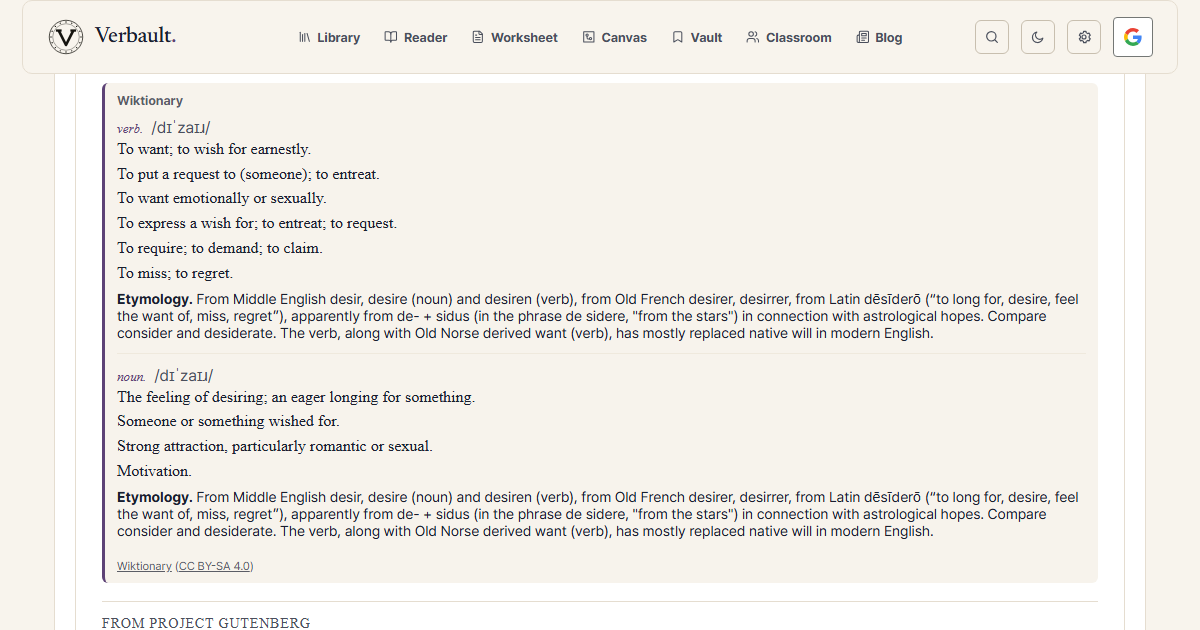
Even desire may belong here. Its page traces it, with a careful "apparently," to Latin dēsīderāre, from the phrase de sidere, "from the stars" — the old idea being that to desire something was to await what the stars might send. The derivation is traditional rather than certain, and the page says so plainly. But it is a lovely thing to find folded into a word as ordinary as desire: a faint memory of looking up and longing for what the sky would bring.
The planets are still in your moods
The old system gave each planet a temperament and handed it to anyone born under its influence. Those temperaments survive as everyday adjectives, each one quietly named after a planet or the god who shared its name:
- saturnine — cold, gloomy, slow to warm. The saturnine page spells it out: people born under the planet Saturn were believed to have exactly that disposition.
- jovial — merry and genial, the gift of Jupiter, whom the Romans also called Jove.
- mercurial — quick, lively, and apt to change in a moment, like the swift planet Mercury.
- martial — warlike and soldierly, from Mars.
Four common words for four kinds of person, and every one of them is an old horoscope in miniature. Call someone mercurial and you are, at the root of it, saying they were born under a fast-moving planet.
The moon's own madness, and a fever from the sky
The moon had its own department. A lunatic, the page notes, is someone moonstruck: the word comes from Latin luna, "moon," and the long-held belief that the moon's changing phases could bring on spells of madness. The same idea sits inside moonstruck itself, and it is why old law once treated the "lunatic" as a distinct kind of person, subject to the moon.
One last word closes the circle in an unexpected place. influenza, the illness, is — its page confirms — simply the Italian word for influence, and a doublet of the English word. When waves of the disease swept through Italy, people named it for the celestial influence thought to cause it: a sickness blamed on the sky. The next time a bad flu is going round, the word you use for it is the same word as the starlight in influence, still faintly glowing under the fever.
See the sky in a word
None of this is hidden knowledge. Every origin above is printed on a word page you can open right now, and finding the astrology in a familiar word takes about a minute.
Look it up in three steps
- Start with the plainest word you can. Open disaster and scroll to the origin. The dis- of misfortune and the astro of "star" sit right there, side by side — the whole belief folded into eight letters.
- Follow it to a stranger one. Open influence, a word you use without a second thought, and read its origin: "emanation from the stars affecting one's fate." Then open saturnine to watch a planet handed straight to a human temperament.
- Read it in a book. Open a classic in the Reader and tap a word like influence, desire, or lunatic. The meaning that fits the sentence comes up first, with the word's origin one tap below — so when a nineteenth-century novelist calls a character saturnine, you can see the planet behind the word without leaving the page.
The sky stopped running our lives a long time ago. The words it left behind never got the message. They are still up there in ordinary speech, quietly reporting the weather of a heaven we no longer believe in.
Comments (0)
Log in to comment.