Why Moby-Dick Is So Hard to Read (And How to Read It Anyway)
The easiest sentence in English, then the wall
Almost everyone can read the first three words of Moby-Dick. "Call me Ishmael" is plain, direct, and probably the most famous opening line in American fiction. The trouble starts the moment it ends. Here is the whole first sentence:
"Call me Ishmael. Some years ago—never mind how long precisely—having little or no money in my purse, and nothing particular to interest me on shore, I thought I would sail about a little and see the watery part of the world."
The rhythm is already doing something the three-word version hid. A few lines on, Ishmael explains why he goes to sea: he does it whenever it is "a damp, drizzly November in my soul." That phrase is the book in miniature, ordinary words bent into an image you have to stop and feel. Moby-Dick is hard, but not in the way people expect. It is rarely that the words are unknown. It is that Melville keeps changing what he is doing with them.
What actually makes it hard
The vocabulary really is rare
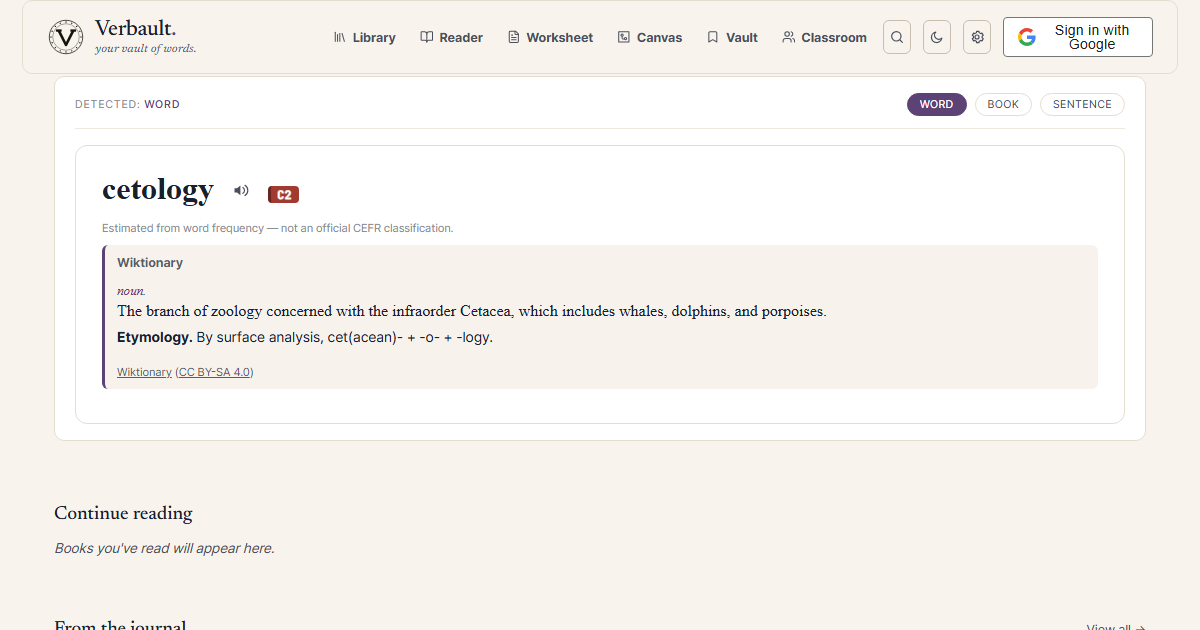
Some of the difficulty is plain: Melville reaches for words most readers genuinely don't know. The book has a whole chapter titled Cetology, the study of whales, and it is exactly as technical as it sounds. Whales are leviathans; the ship bristles with the named gear of 1850s whaling, most of it long obsolete.
Verbault marks words like these with a reading-level badge, so you can see at a glance which ones are rare before you even tap them. A word's level is an estimate, drawn from how often the word turns up across a large body of English rather than an official CEFR grade, but it is a dependable signal: if a word is flagged hard, most readers really haven't met it.
The book keeps stopping to lecture
Just as the chase gets going, Melville pulls over. Whole chapters leave the story behind to catalogue whale anatomy, the history of whaling, the colour white, the making of rope. The Cetology chapter opens by admitting the job is impossible and then doing it anyway:
"Yet is it no easy task. The classification of the constituents of a chaos, nothing less is here essayed."
This is the part that defeats most first-time readers, and it isn't a hard word. It is a hard structure. The book is a novel, an encyclopedia, a sermon, and a stage play by turns, and it never tells you which one the next chapter will be.
The register shifts without warning
Melville's English moves constantly between high and low. One page is plain sailor talk; the next is Shakespearean thunder. Captain Ahab's fixation on the whale is a monomania, a single obsession that has crowded out everything else, and Ahab calls the whale an inscrutable thing, something he cannot read or understand. When he finally explains himself, the prose climbs into a register no sailor ever spoke:
"That inscrutable thing is chiefly what I hate; and be the white whale agent, or be the white whale principal, I will wreak that hate upon him."
You cannot skim that. The grammar alone makes you slow down, which is the point, and also the thing that makes the page feel like work.
How to read it anyway
The encouraging news is in the arithmetic. As we worked out in how many words it takes to read a novel, you don't need every word to follow a book; you need enough of them that the unknowns never pile up. Moby-Dick breaks that math in bursts, since the Cetology chapter spikes the count, which is why a little support goes a long way here. The approach that works:
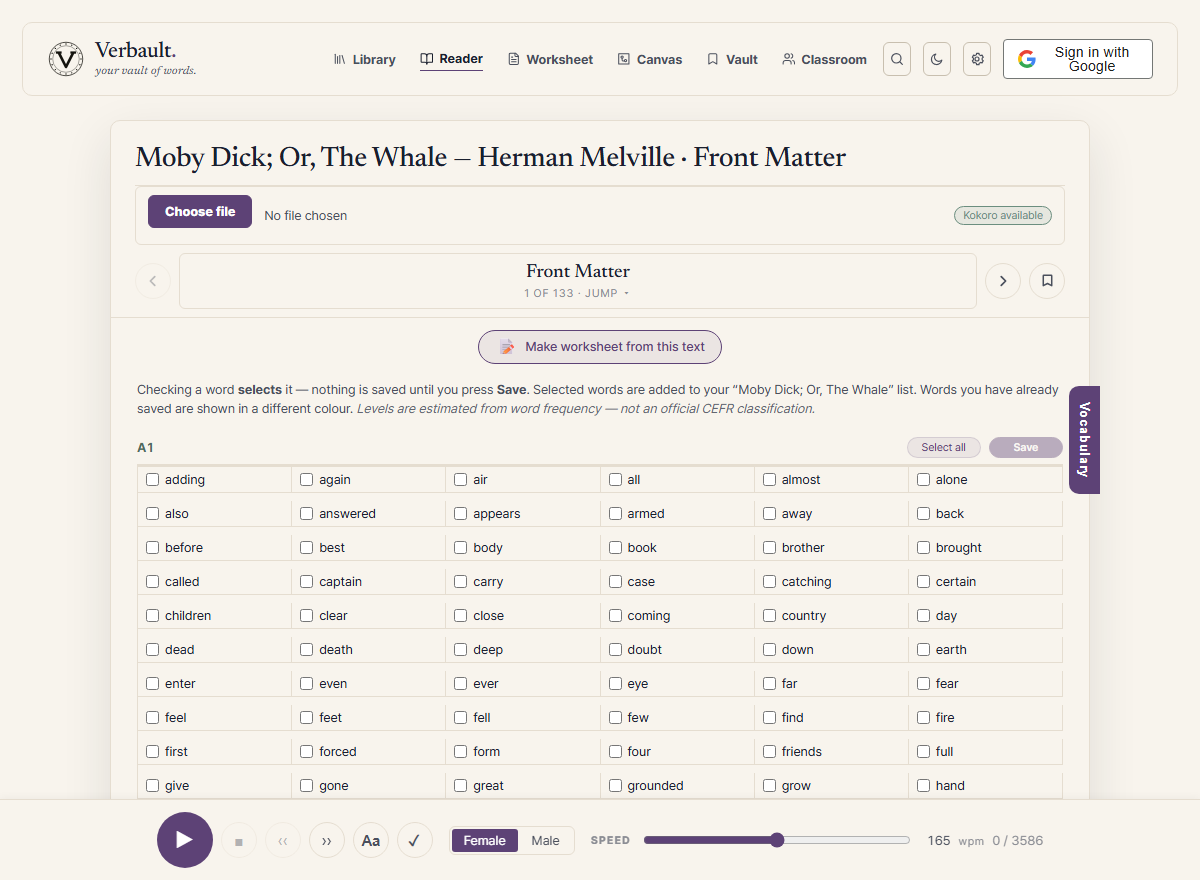
- Read it in the Reader. Open Moby-Dick and the whole text loads with every word tappable, so a rare term costs you a tap instead of a trip to a separate dictionary.
- Tap, don't stall. When you hit cetology or leviathan, tap it. A small card gives you the meaning that fits this sentence and a button to hear the line read aloud, and then you keep moving. Don't look up everything; look up the word the sentence actually turns on.
- Let the digressions be digressions. When a chapter stops the story to lecture, read it lightly. Check the few words you care about and move on. The plot will be waiting in the next chapter.
The Reader's Vocabulary tab makes that third step concrete. It gathers the words from whatever you are reading and groups them by level, from the everyday ones to the rarest, so you can scan a chapter's vocabulary in one place and save what is worth keeping.
Why the difficulty is the point
Moby-Dick is hard because Melville wanted it to be more than a story about a whale hunt, and the strain you feel reading it is the strain of a book trying to hold everything at once. The reward is that few other novels repay slowing down so richly. When Ishmael describes the faraway island where his friend Queequeg was born, he says it is "not down in any map; true places never are." The line is about a person, but it reads like a quiet warning about the book itself. The hard parts are not in the way of the real Moby-Dick. They are where it lives.
Comments (0)
Log in to comment.