Slim, Slender, Skinny: How to Choose Between Near-Synonyms
The thesaurus trap
You are writing a sentence and the word in it feels flat. She had grown thin. True, but plain. So you open a thesaurus, run your eye down the list, and reach for skinny. She had grown skinny. Now the sentence means something you did not intend. Thin was neutral, even tender; skinny sounds like a complaint, or a worry. The thesaurus set the two words side by side as equals. It did not mention that one of them flinches.
This is the quiet problem with synonyms. They are sold as spare parts — swap one for another, same job — and they almost never are. A living language rarely keeps two words for exactly one purpose. When it seems to, one of the pair has usually drifted: it has picked up a feeling, a level of formality, or a shade of meaning the other does not carry. That drift is not noise. It is the whole reason both words survive, and learning to hear it is most of what separates a large vocabulary from a precise one.
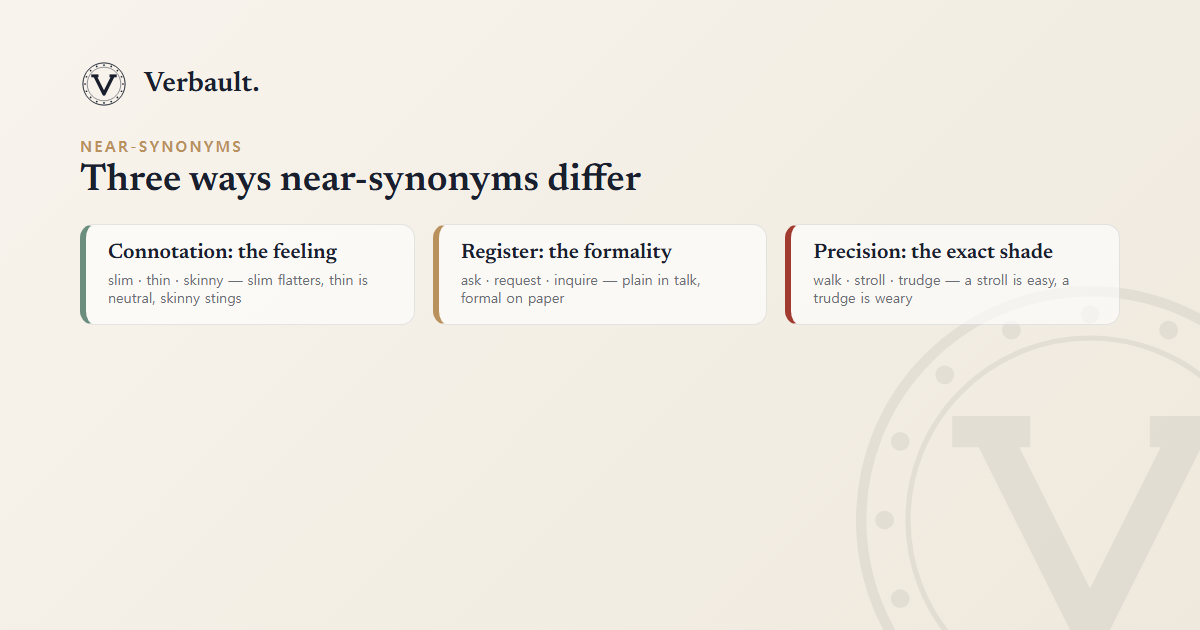
Near-synonyms pull apart in three directions, and it helps to name them.
Connotation: the feeling a word carries
The first and largest difference is attitude. Two words can point at the same fact and feel entirely different about it. Go back to the body: slim and slender approve — they suggest something trim and admired. Thin is neutral, a plain measurement. Skinny, scrawny, and gaunt disapprove, each in its own way: skinny is a little unkind, scrawny adds weakness, and gaunt brings in illness or hardship. One fact — the same low body weight — and a whole range of verdicts on it.
This colouring is called connotation, and it sits on top of a word's plain meaning like a tone of voice. Once you start listening for it you hear it everywhere. Childlike and childish come from the same root and split clean down the middle: one is a compliment (open, unspoiled), the other an insult (petty, immature). Famous, renowned, and notorious all mean "widely known," but the first is neutral, the second admiring, and the third tells you the fame is for something bad. Call a public figure notorious rather than famous and you have added no new fact and a great deal of opinion.
This is why a writer's choice among near-synonyms is often the most revealing thing on the page. It leaks what they think, not just what they see.
Precision: a different shade of the same idea
Not every near-synonym is about feeling. Some name genuinely different things while wearing similar coats, and here the aim is not the right tone but the exact one. Walk is the plain verb; stroll is leisurely, stride is purposeful, trudge is weary, amble is aimless, march is brisk and ordered. They are all walking, and not one of them is interchangeable with the others. To trudge home is a different evening from strolling there.
Few writers worked this register better than Jane Austen, whose whole social world turns on fine gradations of approval. Watch Mr Bingley size up the Bennet sisters at the ball in Pride and Prejudice: Jane is "the most beautiful creature I ever beheld," while her sister is only "very pretty, and I dare say very agreeable." Beautiful, pretty, agreeable — each a smaller coin than the last, and Austen counts them out exactly. A few lines on, Mr Darcy delivers the most famous appraisal in the novel:
"She is tolerable, but not handsome enough to tempt me."
Handsome was the period's high word for a woman's looks, a clear step above pretty; tolerable is faint praise bordering on insult. Darcy has not so much described Elizabeth as ranked her, and the ranking is built entirely from the gaps between near-synonyms. Read Austen without an ear for those gaps and you miss half of what she is saying.
Register: matching the word to the occasion
The third difference is formality, and it is the easiest to handle. Ask, request, and inquire make the same move at three heights: you ask a friend, you request a document, an official inquires. Buy and purchase, begin and commence, help and assist behave the same way — the plain word is at home in speech, the formal one in a contract or a notice. Neither is better; each is right somewhere and stiff or sloppy everywhere else. Choosing well here is simply matching the word to the room.
English is unusually rich in these plain-and-formal pairs, and there is a reason buried in history: roughly, the everyday word is often the old English one, and the formal word arrived later from French or Latin. That story is worth its own telling, and we tell it in why English has two words for almost everything. For choosing, the practical point is enough — when two words mean the same thing, one of them is usually dressed for a more formal occasion.
You learn this by meeting words, not by memorising a chart
Here is the catch: none of this can be tabulated. No one learns that skinny stings and slender flatters from a list of rules. You learn it the way you learned your first language — by meeting each word many times, in real sentences, until the company it keeps tells you how it feels. A thesaurus can hand you the candidates; only reading can teach you which to pick. This is the practical case for reading good writers closely: they choose with precision, and watching them choose, sentence after sentence, is the lesson. An earlier post makes the broader argument for building a vocabulary this way.
How Verbault helps you choose the right word
Verbault is built around exactly this kind of close reading, and a few of its features make choosing between near-synonyms easier. Here is how to use them.
See the cluster. Every word has its own page with a semantic network — a small map of the words gathered around it. Open the page for walk and a whole crowd of nearer verbs fans out around it — saunter, march, promenade, strut, prowl — each a particular way of walking. Tap any word in the Reader and you can follow it through to the same map.
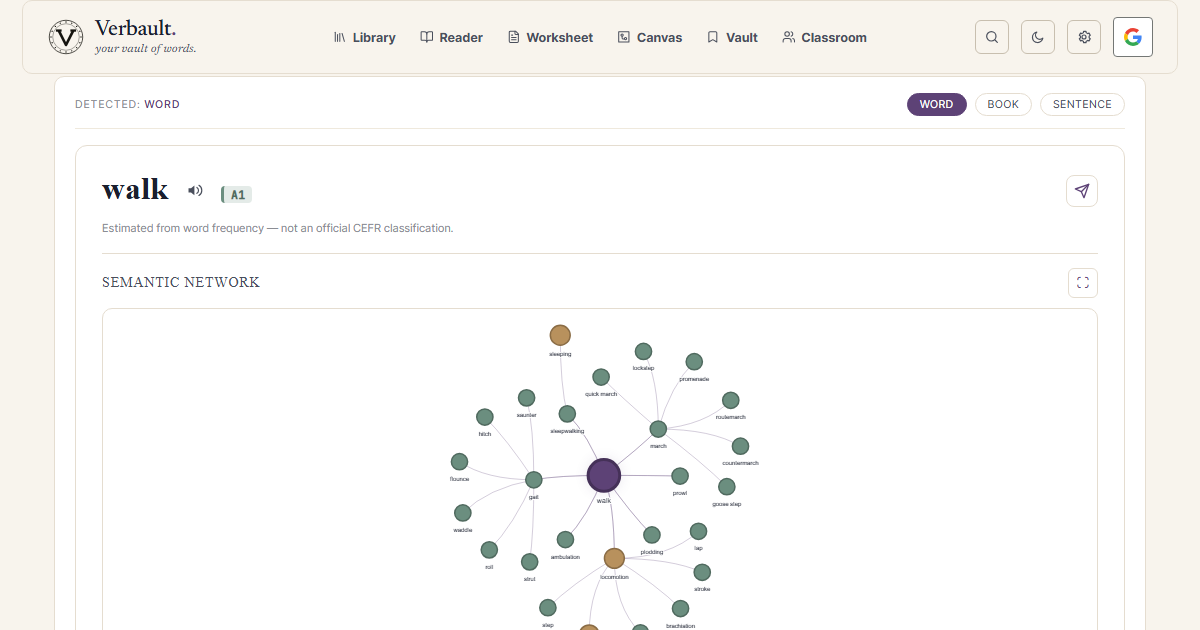
One honest limit, because it bears on how you use the feature. The network shows you which words are neighbours; it does not mark which ones flatter and which ones sneer. There is no plus or minus sign on the graph. Treat it as a way to discover the candidates — the near-synonyms you might not have thought of — and then do the actual choosing in context, where the feeling lives.
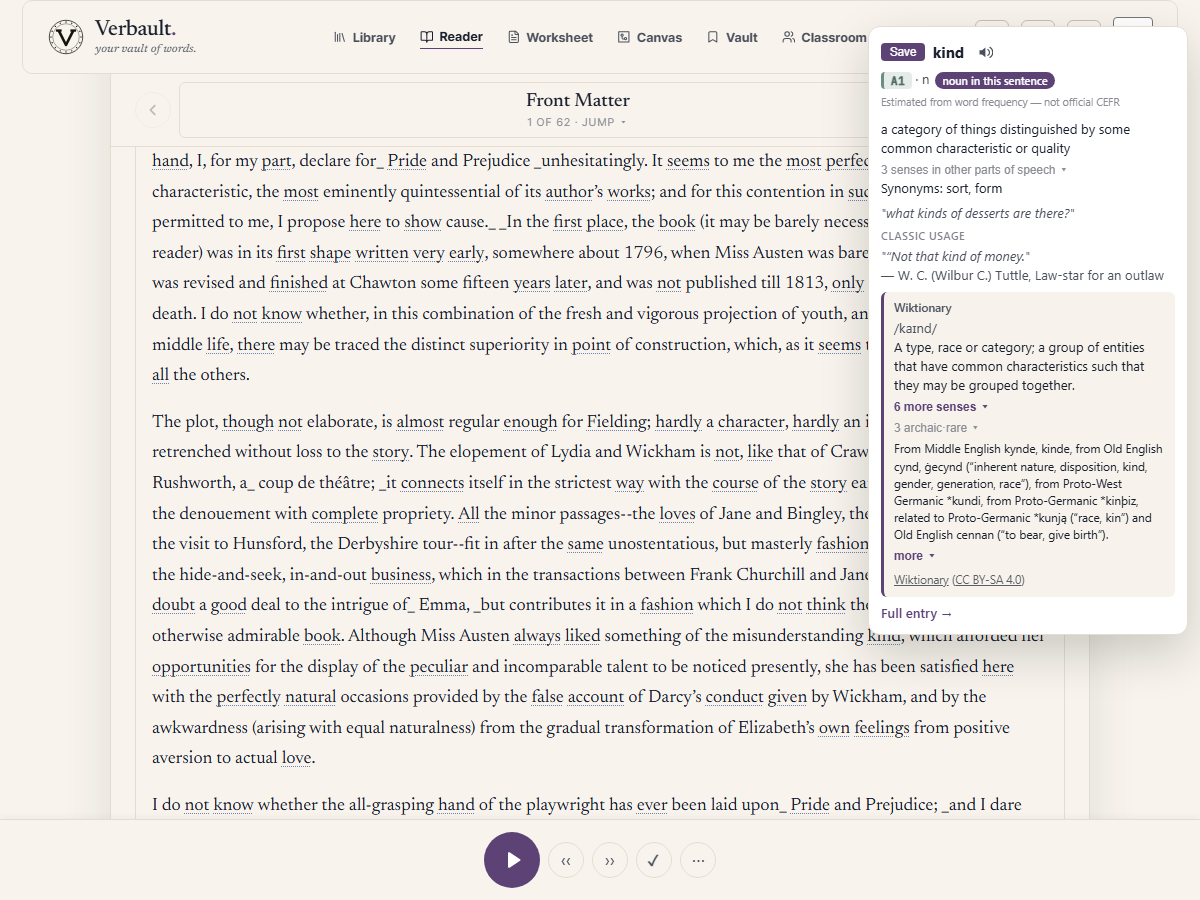
Meet each one in a real sentence. That context is one tap away. In the Reader, open a book such as Pride and Prejudice and tap a word: a small card shows the meaning that fits this sentence, the word's reading level, a few of its synonyms, and a button to hear it spoken, all without taking you off the page. Seeing a near-synonym at work in a real sentence — a careful writer's sentence at that — is where its feel comes from.
Keep the ones you want to use, and bring them back. Recognising a word is not the same as being able to reach for it. Save the near-synonyms worth owning to your Vault as you read, and Verbault returns them on a schedule, so a word moves from one you merely understand to one you can actually produce. The post on passive and active vocabulary explains why that last step is the one that makes a word truly yours.
The short version
Synonyms are not spare parts, and a thesaurus is a box of candidates, not a set of equals. When two words mean nearly the same thing, ask what separates them: the feeling they carry, how formal they are, or the exact shade they name. Then pick the one that fits — and the only dependable way to know which fits is to have met it, many times, in sentences written by people who chose with care. Read that way and the choice stops being a guess. Slim, thin, skinny: never quite the same word again.
Comments (0)
Log in to comment.