Why English Has Two Words for Almost Everything
A swineherd and a jester
Near the start of Walter Scott's Ivanhoe, two servants stand in a forest and argue about pigs. Wamba, a jester, is needling Gurth, a swineherd, about what to call the animals in his charge.
"Why, how call you those grunting brutes running about on their four legs?" demanded Wamba.
"Swine, fool, swine," said the herd, "every fool knows that."
"And swine is good Saxon," said the Jester; "but how call you the sow when she is flayed, and drawn, and quartered, and hung up by the heels, like a traitor?"
"Pork," answered the swine-herd.
That is the whole joke, and it is also a real fact about English. While the animal is alive and rooting in the mud, it keeps its plain old name, swine. The moment it is killed, cooked, and carried to the lords in the castle, it takes a French one, pork. Wamba runs the same trick down the rest of the farmyard: the live beast "continues to hold his Saxon epithet" in the field, "but becomes Beef, a fiery French gallant," at the table. The living ox is Saxon; the meat is Norman. (Scott's novel is free to read on Project Gutenberg if you want the scene whole.)
This is not a flourish Scott invented for period colour. It is the clearest illustration anyone has written of something built into the language itself: English very often carries two words for one thing, a plain one and a formal one, and the reason is a date.
One island, two vocabularies
In 1066, William of Normandy won the Battle of Hastings and took England. For about the next three hundred years the people who held power — the court, the law, the church, the kitchens of the great houses — conducted their business in French, while the people who worked the land went on speaking English. The two languages lived side by side, sorted by class, and English steadily absorbed thousands of French words, and through French, Latin ones.
When things finally settled, English had not thrown its old words out. It had kept them and stacked the new ones on top. So the everyday, around-the-hearth word tends to be the old English one, and the official, written-down word tends to be the French or Latin one. Swine and pork is the famous pair, but once you have noticed the pattern you start finding it everywhere.
The pairs are everywhere
Here is a small field guide. The left column holds the older, plainer, Anglo-Saxon word; the right holds the formal newcomer from French or Latin. In nearly every row the two mean almost the same thing — but they do not feel the same.
| Plain (Anglo-Saxon) | Formal (French / Latin) |
|---|---|
| ask | inquire |
| begin | commence |
| end | conclude |
| help | aid |
| free | liberty |
| kingly | royal |
| deep | profound |
| see | perceive |
| fear | terror |
| gut | intestine |
| home | residence |
You ask a friend where she lives; you inquire on a form. A bad week is deep trouble; a philosopher writes something profound. You feel the difference before you can explain it: the left-hand words are short, blunt, and old, and the right-hand ones are longer, cooler, and dressed for the office.
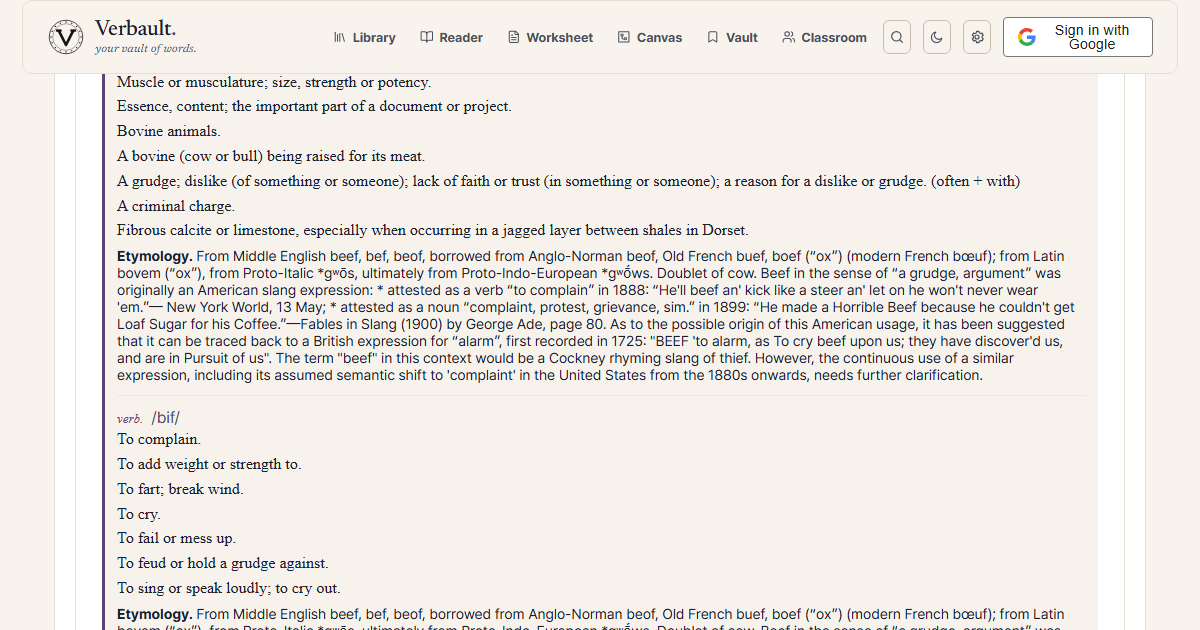
You can watch the split for yourself, a single click apart. Open the Verbault word page for beef and scroll to its Etymology: the word runs back through Anglo-Norman beof and Old French buef, "ox," to the Latin bovem. Then open ox: it goes straight back through Old English oxa to an ancient Germanic root, with no French anywhere in sight. Same animal, two words, two completely different histories — exactly the split Wamba was laughing about.
What the second word is for
If the two words mean the same thing, why keep both? Because the second one does a job the first cannot: it sets a tone. English reaches for its Saxon layer for warmth and plain talk, and its Latin layer for distance, formality, and authority. Swap one for the other and the temperature of the sentence changes.
This is a good part of what we mean when we call a writer "plain" or "elevated," and the best writers play the two layers against each other on purpose. Jane Austen is a master of the cool register; her irony often lives in the gap between a grand Latin word and a small human truth. Pride and Prejudice opens with "It is a truth universally acknowledged" — a stately, Latinate phrase — and then attaches it to nothing weightier than local gossip about which young woman a rich man ought to marry. The comedy is in the register. You can read the line in context in the Reader.
The rule is a tendency, not a law
It would be tidy to say short word equals Saxon, long word equals French, but English is never that obedient. Plenty of short, homely words came from French and have been here so long they feel native: very, use, try, push, carry, face. And not every formal word has a plain twin waiting beside it. The Saxon-and-Latin split is a strong tendency you can lean on, not a rule you can apply by counting syllables — which is exactly why reading widely teaches it better than any list could. We looked at a related kind of drift, words whose meaning shifted inside the classics, in an earlier piece.
Hearing the layers in Verbault
Once you know the two layers are there, you start to hear them, and a good reading setup makes that easier. Here is how to use Verbault to listen for the seams.
- Check a word's pedigree. Open any word page — try beef next to ox — and read the Etymology line. If the trail runs through Old French or Latin, you are looking at a Norman newcomer; if it goes straight back to Old English, the word is part of the old bedrock. Seeing the two histories side by side is the quickest way to feel the pattern in your own ear.
- Read with the layers in front of you. Open a book in the Reader — A Tale of Two Cities is a good one, swinging between high feeling and plain speech within a single paragraph. Tap any word and a small card shows its meaning in that sentence, its reading level, and a button to hear it spoken.
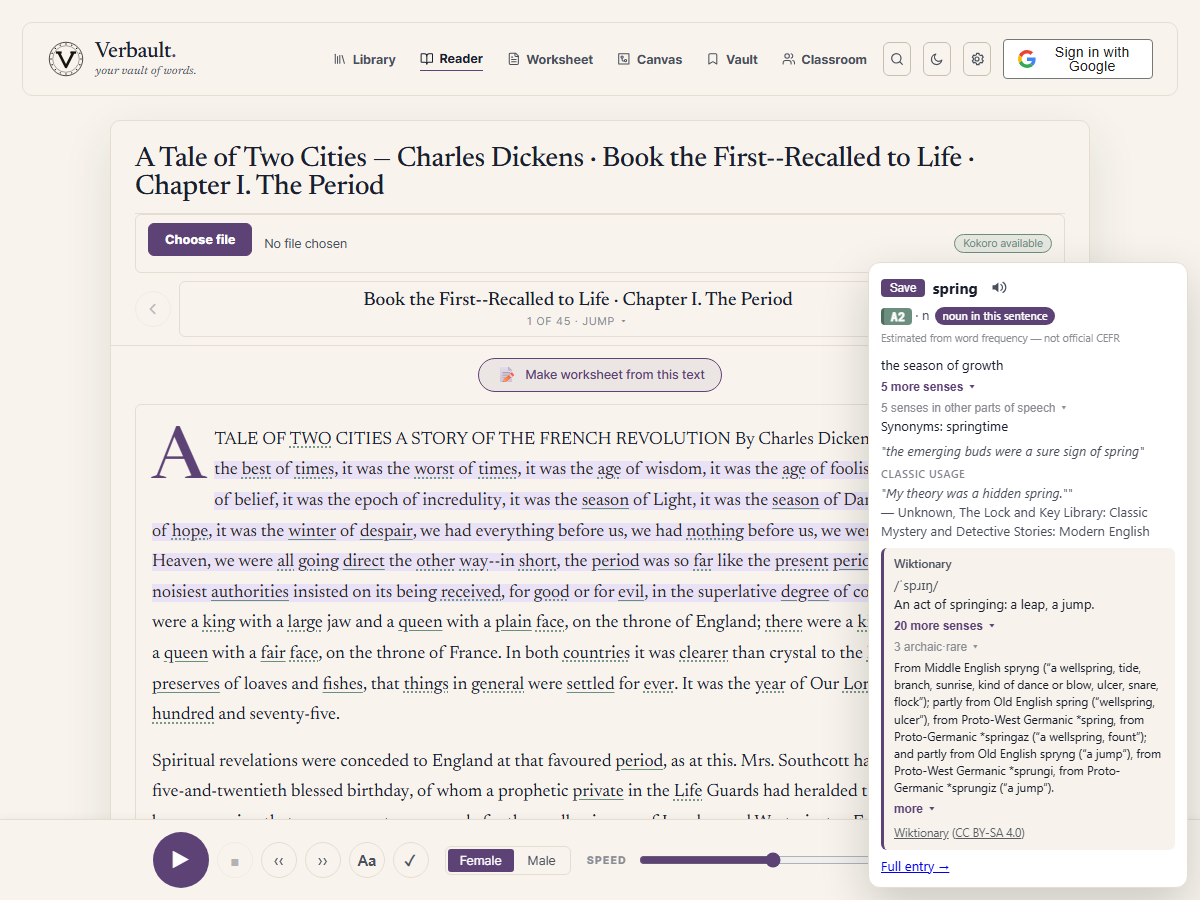
- Collect the formal half. When you catch a Latinate word doing work a plain one could not, save it to your vault from that same card. Over a few weeks you build a private collection of the cooler, more formal side of English — the words that change a sentence's temperature — and you begin reaching for them on purpose.
If etymology is new to you, why word origins help you remember makes the case that knowing where a word comes from is one of the surest ways to keep it, and how the dictionary and WordNet work together explains what you are seeing on each word page. But the short version is the one Wamba handed us eight hundred years ago. The pig in the field and the pork on the plate are the same animal. English simply kept both names — and left you to choose which one to use.
Comments (0)
Log in to comment.