Words That Were Once People: How Names Like Quixote and Boycott Became Everyday English
A man named Quixote
Call a plan quixotic and you have said a great deal in one word: it is noble, a little absurd, and almost certain to fail. The plan tilts at problems the way a knight charges a windmill, mistaking the ordinary world for something grander and more dangerous than it is.
That picture is not an accident. Quixotic is the surname of a man — Don Quixote, the ageing gentleman who reads too many tales of chivalry and rides out to revive them in Don Quixote, the 1605 novel by Miguel de Cervantes. He is the one who charges the windmills, certain they are giants. Four centuries later the knight is mostly forgotten and the adjective is everywhere, doing his work without his name attached.
English is full of these: words that were once people.
How a name becomes a word
The technical term is an eponym — a word made from a proper name. The mechanism is nearly always the same. A figure, real or invented, becomes so completely identified with one quality that the name starts to stand in for the quality itself. First it is a reference you are expected to catch. Then it is just a word, and most people forget there was ever a person.
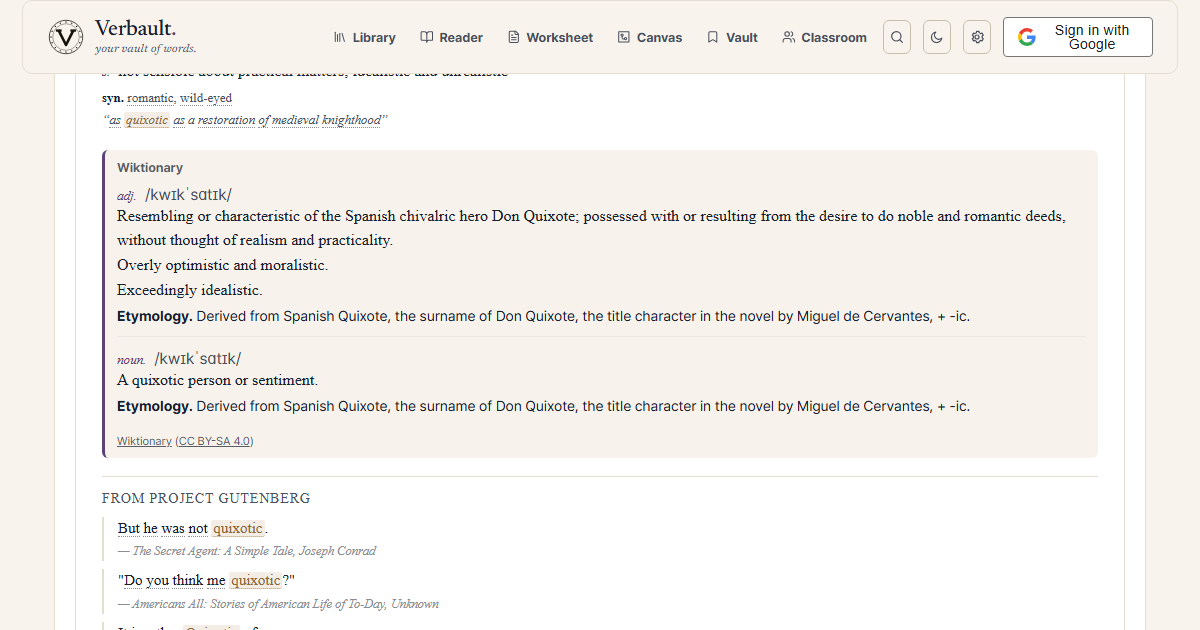
You can watch that happen in the etymology of almost any eponym. On Verbault, every word page traces a word back to its root, and for an eponym the trail ends at a name. The page for quixotic says so plainly: derived from the surname of Don Quixote, the title character in Cervantes's novel.
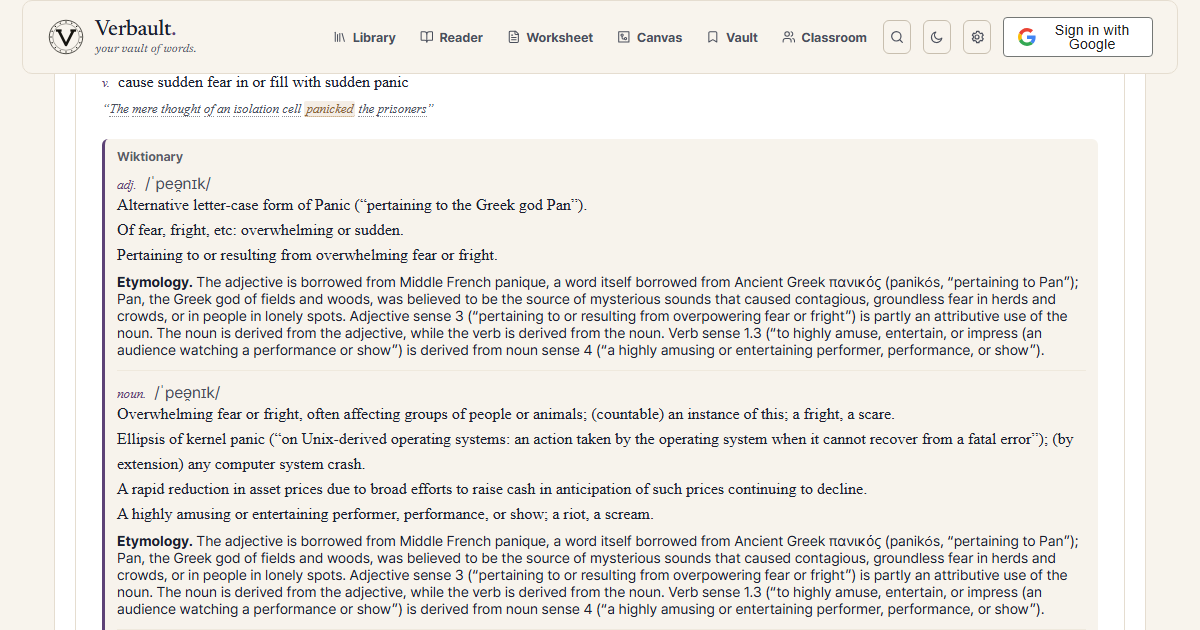
Some of the oldest examples come from myth, where the figure was a god before it was a word. When a sudden, groundless fear runs through a crowd, we call it panic — from Pan, the Greek god of fields and woods, whose presence in a lonely place was said to fill travellers with exactly that unreasoning dread. To tantalize someone is to dangle a reward and keep pulling it away; the word comes from Tantalus, condemned in the underworld to stand in water he could never drink, beneath fruit he could never reach. Even mentor, the plain word for a trusted guide, began as the name of a character in Homer's Odyssey — though it took a French novel, centuries later, to wear the name down into the everyday noun we use now.
When the person was real
The figure does not have to be invented. Some of the most ordinary words in English were the names of people who actually lived, and a few of those stories are worth the detour.
The sharpest is boycott. In 1880, Captain Charles Boycott was a land agent in County Mayo, Ireland, collecting rents for an absent landlord. When he refused to lower them during a hard season, the tenants did not riot — they simply stopped dealing with him. Shops would not serve him, labourers would not bring in his harvest, the postman would not carry his letters. The campaign was so complete, and so widely reported, that his name became the word for the tactic within months. He left Ireland that winter; the word stayed.
Others are quieter. A sandwich is named for the Earl of Sandwich, who liked to eat without leaving the card table. A silhouette recalls Étienne de Silhouette, a French finance minister so associated with doing things on the cheap that his name attached to the cheapest kind of portrait, a plain black outline. The guillotine carries the name of Joseph-Ignace Guillotin, a doctor who did not invent it but proposed it as a more humane method of execution, and whose family later changed their own name to escape the association. A maverick was Samuel Maverick, a Texas rancher who declined to brand his cattle, so that any unbranded calf on the range came to be called a maverick — and from there, anyone who would not run with the herd.
The origin is a memory aid, not a rule
There is a trap worth naming here. Knowing where a word came from tells you how it was born, not what it means today, and the two can drift a long way apart.
Quixotic no longer requires a windmill, a knight, or even idealism in the heroic sense; it can describe a hopelessly impractical budget. A nemesis was once a specific goddess of retribution, but your nemesis at work is just a rival, no divinity involved. To tantalize needs no underworld. The name is a hook to hang the meaning on, and a story that makes it stick, but the current sense is set by how people use the word now — not by the figure it started from. Treat the origin as the thing that helps you remember, and let usage decide the rest.
How to spot one yourself
Once you start looking, eponyms turn up constantly, and Verbault makes them easy to check. The tell is always a capitalised name sitting in the etymology.
- Open the word's page. Go to a page like quixotic or panic and read the Etymology line. Every word page has one, tracing the word back to its source.
- Look for a name. If the trail ends at a capitalised proper noun — a person, a god, a place — you have found an eponym. The name is usually the whole story.
- Meet it in a sentence. Tap the same word inside the Reader to see how it behaves in real text, with its reading level and the meaning that fits that sentence.
- Keep it. Save the word to your vault from that card. An eponym is one of the easiest kinds of word to retain, because it arrives with a person already attached.
If that last point sounds familiar, it is the argument we made in why a word's origin is the easiest way to remember it: a word with a story behind it is a word you stop forgetting, and an eponym is that idea in its purest form. For words that shifted meaning without changing shape, our piece on words that changed meaning in the classics follows the same habit, and how the dictionary and WordNet work together explains the rest of what each word page is showing you.
The people in the dictionary
There is something quietly companionable about a language that keeps its people this way. Pan is still loose in the woods every time a crowd panics. Captain Boycott lost his argument in Mayo and won a strange sort of immortality for it. Don Quixote never reached the giants he charged at, but the word for charging them anyway outlived everyone who laughed at him. Read closely enough and the dictionary turns out to be half full of names.
Comments (0)
Log in to comment.