When ‘Nice’ Meant Foolish: Words That Changed Meaning in the Classics
The word that did for everything
In Northanger Abbey, written around 1803, Catherine Morland keeps calling things nice, and Henry Tilney finally teases her for it. She has just pronounced Mrs Radcliffe's Udolpho "the nicest book in the world," and he pounces on the word:
"The nicest—by which I suppose you mean the neatest."
He keeps at it until she protests, and then delivers the line that has outlived the joke:
"Oh! it is a very nice word indeed! it does for everything."
Tilney is not being pedantic for its own sake. He is listening to a word lose its edges in real time. Nice had once meant something exact, and by Austen's day it was sliding toward meaning almost anything pleasant. Two centuries on it finished the trip: today nice is the blandest praise in English, the word you reach for when you have nothing precise to say. Austen heard it happening and handed the complaint to Tilney.
A word's meaning is a moving target
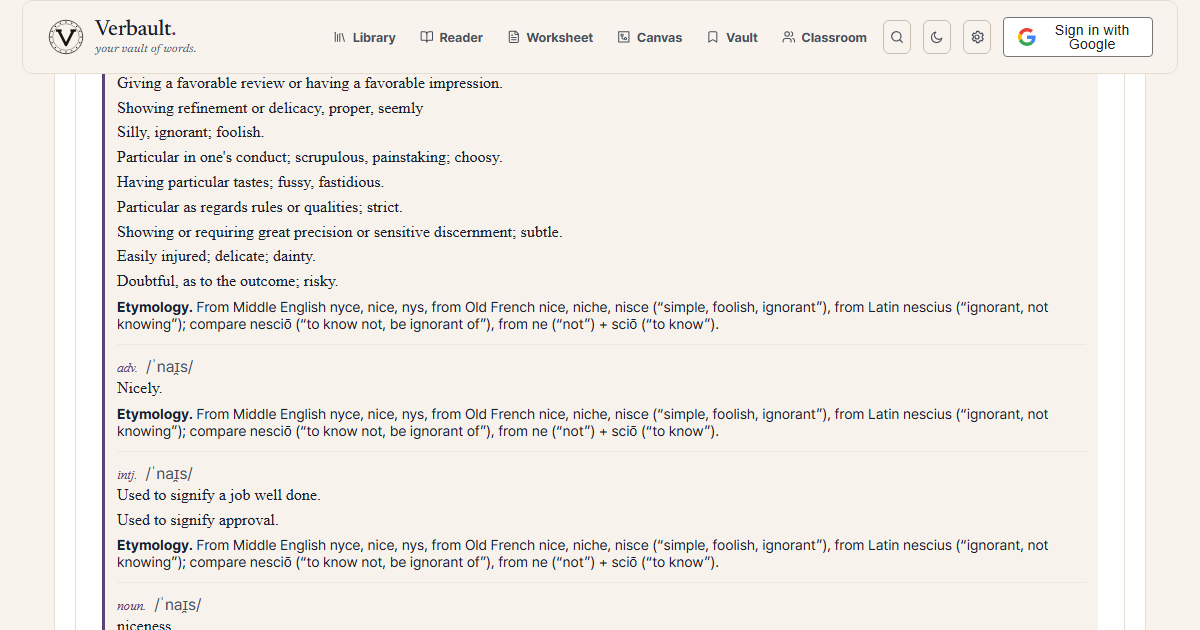
What makes nice worth the detour is where it began. It descends from the Latin nescius, "ignorant" — literally not-knowing. In Middle English a nice person was foolish, simple, the opposite of shrewd. From there it drifted through "fussy" and "precise" (a sense that still survives in a nice distinction) before arriving, around 1800, at the vague approval Tilney mocks. One word, four different jobs across six centuries, each sense quietly shouldering out the last.
That drift is not a quirk peculiar to nice. English words wander, and old books are full of them caught mid-journey — used in a sense that was ordinary then and is nearly invisible now. Once you notice the pattern you keep stepping on it. Here are two more worth knowing, then a quick way to spot them yourself.
‘Awful,’ when it still meant awe
To us awful means bad. To Mary Shelley it meant full of awe — overwhelming, sublime, the kind of thing that makes you go quiet. In Frankenstein (1818), Victor describes the mountains and the word does its older work:
"The sight of the awful and majestic in nature had indeed always the effect of solemnising my mind."
Set awful beside majestic and the meaning is unmistakable: this is admiration, not disgust. The word kept that weight through much of the nineteenth century and then collapsed into a plain synonym for "very bad," exactly as terrible and dreadful did. All three started as words for things that inspired dread or awe, and all three ended up meaning, roughly, "I didn't enjoy it."
‘Fond,’ before it was affectionate
A fond parent today is a loving one. For Shakespeare the word leaned the other way: fond meant foolish, doting, soft-headed. In Hamlet, the prince vows to scrub his memory of everything trivial — and chooses his adjective carefully:
"from the table of my memory / I'll wipe away all trivial fond records."
Fond sits next to trivial because that is the company it kept: silly, lightweight, not worth keeping. The affection came afterward, once "doting on someone foolishly" softened into "being fond of them." The old foolishness is still in there, fossilised; we just stopped hearing it.
A short field guide
Once you start watching for it, the buried senses turn up everywhere. A few to keep in mind in anything written before 1900:
- quick once meant alive, not fast — the sense preserved in "the quick and the dead."
- want often meant to lack rather than to wish for. The most famous sentence in Pride and Prejudice turns on it: a single man of good fortune "must be in want of a wife" — must be missing one.
- brave could mean splendid, finely turned out. A "brave new world" is a dazzling one before it is a courageous one.
- girl, in Middle English, meant a young person of either sex; it narrowed to "female child" only later.
None of these will stop you following a sentence. They will, now and then, make a sentence mean something sharper than you first assumed.
How to catch it yourself
You don't need a glossary open beside the book. You need to notice when a familiar word sits slightly wrong in its sentence, and then check it. The Verbault Reader turns that into one tap.
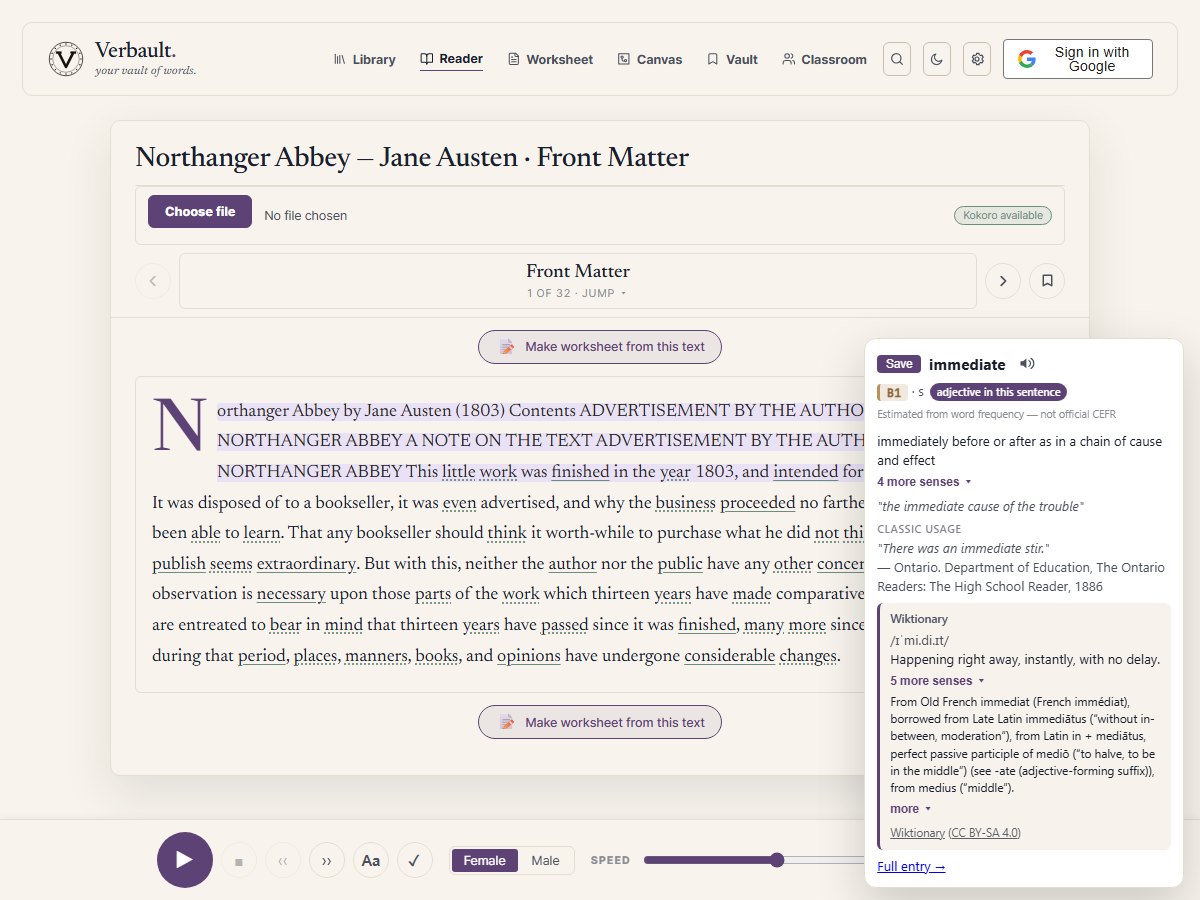
- Open the book. Start Northanger Abbey in the Reader. The whole text loads with every word tappable.
- Tap the word that feels off. When Tilney calls something nice and it doesn't quite land, tap it. A small card shows the word's meaning, how common it is, and a button to hear the sentence read aloud — without sending you off the page.
- Open its word page. Tap through to a page like nice to see its senses, its reading level, and — the part that matters here — its etymology. Nice traces back through Old French to the Latin nescius, "ignorant"; the page lays the trail out plainly, from "not-knowing" to "foolish" to the mild approval we use today.
The habit pays off past single words. If you already save vocabulary as you read, our note on why a word's origin is the easiest way to remember it walks through the same loop: meet a word, find where it came from, and it stops slipping away.
Why it's worth the trouble
A word that changed meaning is a small piece of history that survived by hiding inside a sentence you can still read. Catching one does more than clear up a line; it tells you the page is older and stranger than it looks, and that the people in it were reaching for senses we have since misplaced. Nice, it turns out, was never bland. We made it that way.
Comments (0)
Log in to comment.