How to Read Shakespeare's English Without a Glossary
"Wherefore art thou Romeo?" is the most misread line in English. Picture Juliet at her window, and the natural assumption is that she is searching the dark for Romeo, calling out to find where he has gone. She is doing nothing of the kind. He is already below her, hidden in the orchard. Wherefore does not mean where. It means why — and her question is not about his location but about his name. Why must you be Romeo, she is asking, why a Montague, the one family I am forbidden to love? The whole balcony scene turns on a single word that four centuries quietly changed under our feet.
That word is the difficulty of Shakespeare in miniature. The trouble is rarely that the vocabulary is alien; most of his words are words you use every day. It is that a thin layer of older grammar, plus a handful of common words that have since shifted meaning, sits between you and sentences you could otherwise read with ease. The encouraging part is that the layer is thin and finite. Learn a few pronouns, two verb endings, and a dozen false friends, and most of the fog lifts. Here is the whole layer, in order.
Thou, thee, thy, thine: the missing singular "you"
Modern English has one word, you, for whoever you are addressing — one friend or a whole crowd, a king or a child, all you. Shakespeare's English had two sets, and keeping them apart unlocks more than any other single thing.
The everyday set is thou and its relatives, and they map cleanly onto words you already know:
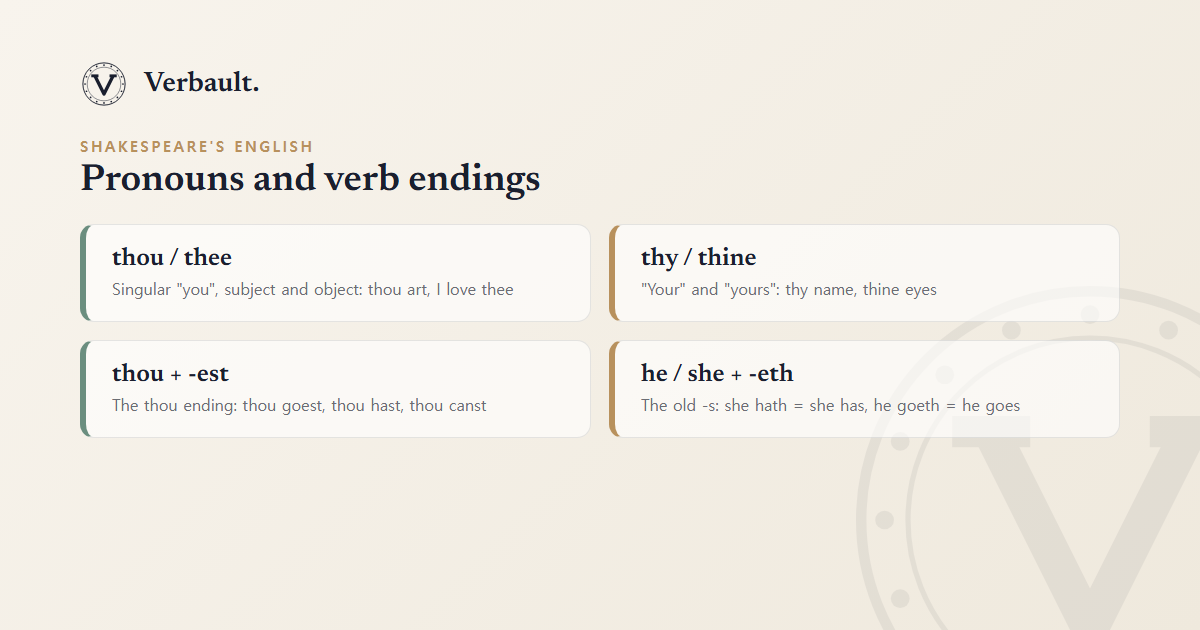
- thou is you as the subject — thou art is "you are."
- thee is you as the object — I love thee is "I love you."
- thy is your — thy name.
- thine is yours, and also your in front of a vowel — thine eyes, the fault is thine.
Set against them is you, with its older subject form ye, which did the same jobs for more than one person, or for a single person addressed with formality. So far this is only vocabulary: thou is the singular, you the plural, exactly as German keeps du and ihr, or French tu and vous.
The part worth slowing down for is what the choice means. Thou was the intimate, familiar form — what you said to a close friend, a child, a servant, or God. You was the respectful, formal one. That makes the choice between them a live signal, and Shakespeare plays it constantly. A character who suddenly switches from you to thou may be reaching for tenderness, or pulling rank, or sliding into open contempt, and which it is depends on the scene. When a noble addresses an equal as thou, it can be a calculated insult; when two lovers move to thou, the distance between them has just closed. None of that lands if the words look like quaint noise. Once you hear thou as the warm, close form, you start reading the temperature of every exchange.
Two verb endings, and the verbs turn modern
After the pronouns, the next thing that makes a line look ancient is a pair of verb endings. There are only two, and each has a one-step translation.
Thou takes an -est (often shortened to just -st) on its verb: thou goest, thou knowest, thou hast, thou canst, thou wilt. The ending is doing nothing more than agreeing with thou, the way am agrees with I. Take it off and you have the plain modern verb: thou goest is simply "you go."
The third person — he, she, it — takes an -eth (or -th) exactly where today we use -s: he goeth is "he goes," she hath is "she has," it doth is "it does." This one is even easier, because the swap is mechanical: wherever you see -eth, read -s.
A few of the commonest verbs are irregular, and they are worth knowing on sight because they turn up on nearly every page: art ("are," with thou), hast and hath ("have" and "has"), dost and doth ("do" and "does"), wilt ("will"), shalt ("shall"). So thou hast is "you have," and what dost thou know? is "what do you know?". Run those two substitutions — -est away, -eth into -s — and a sentence that looked like another language resolves into one you have been reading your whole life.
The real traps are false friends, not rare words
If the pronouns and endings are the scaffolding, the false friends are where you actually trip. These are ordinary words, still in the language, that meant something different in Shakespeare's day — so you read straight past them, sure you understood, and miss the line. Wherefore is the famous one, but it keeps plenty of company:
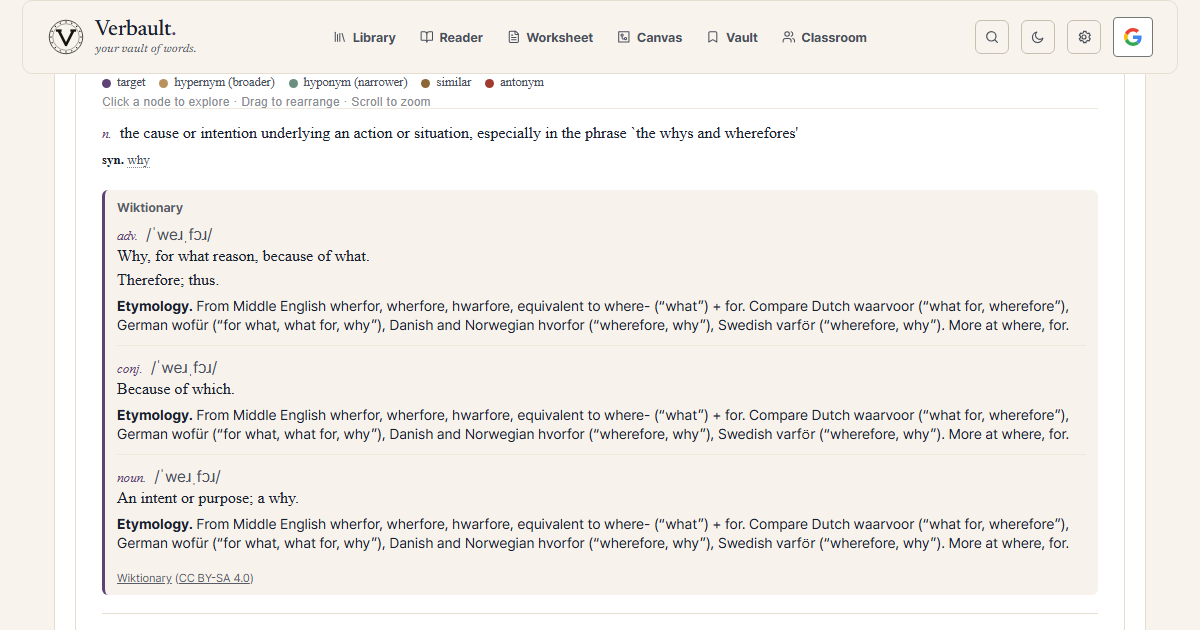
- wherefore means why, not where.
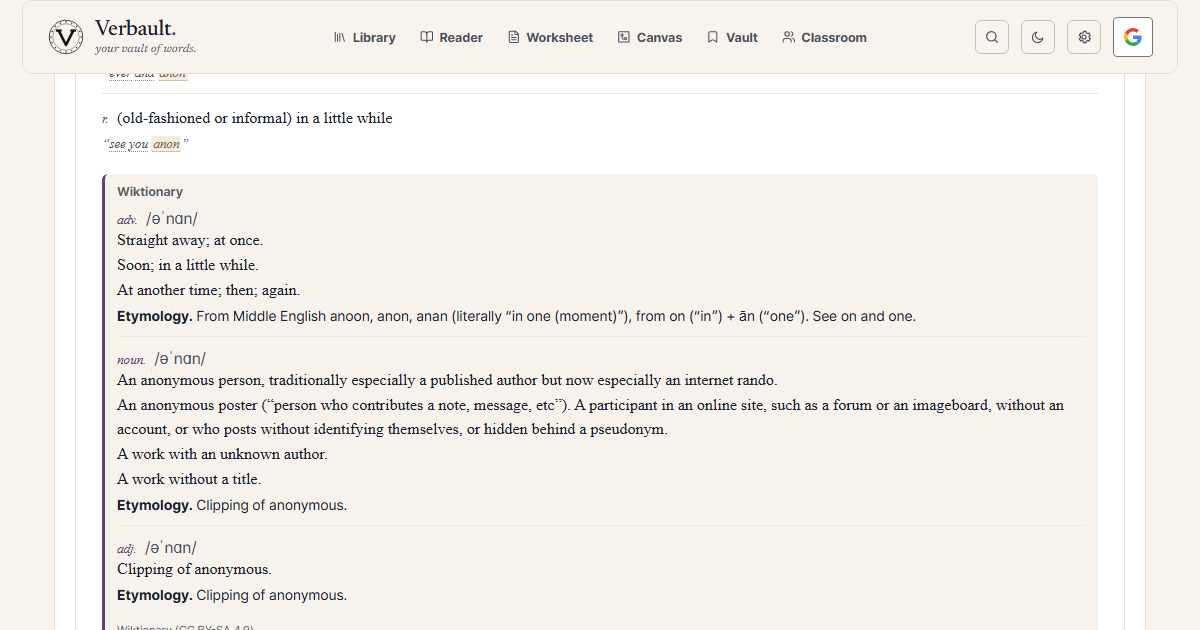
- anon means soon, in a moment. A servant called from offstage answers "Anon, anon!" — "Coming, coming!"
- ere means before — ere long is "before long," ere I go is "before I go."
- but and an can each mean if: "an it please you" is "if it please you."
- still often means always, continually — "I am still the same" leans toward "always."
- want usually means lack rather than desire, one of several shifts we trace in words that changed meaning in the classics.
- prithee is "I pray thee" worn down to one word: please.
- mark means pay attention to — "mark my words," still half-alive today.
None of these will stop you if you are watching for them. The skill is to notice the small jolt when a familiar word sits oddly in its sentence, and to treat that jolt as a signal to check rather than to read on. A word page makes the check quick. Look up wherefore and its history lays the answer bare: it is where-, an old form of what, joined to for — "for what," which is exactly "why." Look up anon and it unpacks to "in one moment," the very sense a servant reaches for when he shouts it up a staircase; ere traces straight back to an Old English word for "before."
Contractions and turned-around word order
Two smaller things finish the layer. The first is contractions, and they are friendlier than they look: 'tis is "it is," 'twas "it was," o'er "over," ne'er "never," e'er "ever," 'gainst "against." Most exist to keep a line on its beat — Shakespeare wrote in a strict ten-syllable measure, and a clipped word often fit where the full one would not. Read them aloud and they stop being strange almost at once.
The second is word order. Verse and high feeling bend the usual subject-verb-object line for emphasis, for rhyme, or for rhythm: "Whom hath he wronged?", "this above all," "speak I must." When a sentence reads back to front, the cure is the same one that works for any tangled sentence — find the main verb first, then ask who is doing it, and the rest settles into place. We walk through that move in detail in how to read a long sentence.
How to read Shakespeare in Verbault
You do not need a glossary in your lap and a footnote for every line. You need the older layer above held loosely in your head, and a fast way to check the few words it does not cover. The Reader is built for exactly that kind of reading.
- Open a play and start reading. Go to Hamlet and press Read; the text loads scene by scene with every word tappable. One honest limit, stated plainly: tapping a single word like thou will not teach you the grammar — that pattern is the thing you carry in with you. What a tap does give you is the meaning, reading level, and pronunciation of the genuinely unfamiliar vocabulary, so a rare word costs you a second instead of a trip to a separate dictionary.
- Hear the lines read aloud. Shakespeare wrote for the voice, and a spoken line half-parses itself. Press the speaker control in the player bar and the current line is read in a natural voice while it stays highlighted; the rise and fall of the verse shows you where the stresses land and where an inverted sentence breaks into phrases. The text-to-speech post covers the voices and controls.
- Tap the false friends to confirm the modern sense. When wherefore, anon, or ere sits oddly, tap it — or open its word page — and read the etymology: wherefore unpacks to "for what," anon to "in one moment." The reading-level badge beside each tells you how rare the word has become, on the same scale the Reader uses everywhere; see reading levels and the dictionary.
- Keep the line, not the word. Shakespeare's hard moments are usually whole phrases, not lone words, so when one stops you, save the sentence. A bookmark stores the full line with the scene it came from, which is the only thing that explains an inversion or an old idiom once you come back to it cold.
The short version
- thou / thee / thy / thine is just singular you / you / your / yours — and thou is the intimate form, so a character switching to it is never doing it idly.
- -est goes with thou; -eth is the old -s. She hath is "she has." Strip the endings and the verbs are modern.
- The traps are false friends, not rare words: wherefore is why, anon is soon, ere is before.
- Read it aloud, and keep the whole line when one stops you, not the single word.
The language is not a wall. It is a clear pane with four or five smudges on it — the pronouns, the two endings, the contractions, the handful of shifted words. Wipe those and Shakespeare reads almost like anyone else, only better. Open Hamlet and try a scene with the layer in mind; for the wider habit of reading old books for the words inside them, see why a word's origin is the easiest way to remember it. And the next time someone tells you "wherefore art thou" means "where are you," you will know that Juliet, on her balcony, was never asking where. She was asking why.
Comments (0)
Log in to comment.