Smog, Brunch, Chortle: A Field Guide to Portmanteau Words
In Through the Looking-Glass, Alice asks Humpty Dumpty to explain the nonsense words in Jabberwocky, and he obliges like a man who has given it real thought. "'Slithy' means 'lithe and slimy,'" he tells her, and then names the trick: "You see it's like a portmanteau — there are two meanings packed up into one word." You can read the whole exchange yourself; the book sits in the library as Through the Looking-Glass, one tap from the Reader.
The suitcase word
That offhand line gave English the name for one of its quietest habits. A portmanteau was a stiff leather travelling bag, the kind that opened on a hinge into two compartments — the right picture for a word with two meanings folded inside it. The name has been doing double duty ever since. Look up portmanteau today and the page lists both senses side by side: a large travelling bag, and a word made by joining two others. One of its two meanings is the very thing it describes.
Carroll didn't just name it — he made some
The pleasing part is that Carroll wasn't only theorising. He coined blend words himself, in that same poem, and two of them outlived the nonsense and walked into ordinary English.
Chortle is the survivor almost everyone uses without knowing where it came from. The dictionary keeps the receipt: its origin is "perhaps a blend of chuckle + snort," coined by Carroll in Jabberwocky. You can hear both parents in it — a chuckle and a snort, folded into the same small noise — which is exactly what the word means.
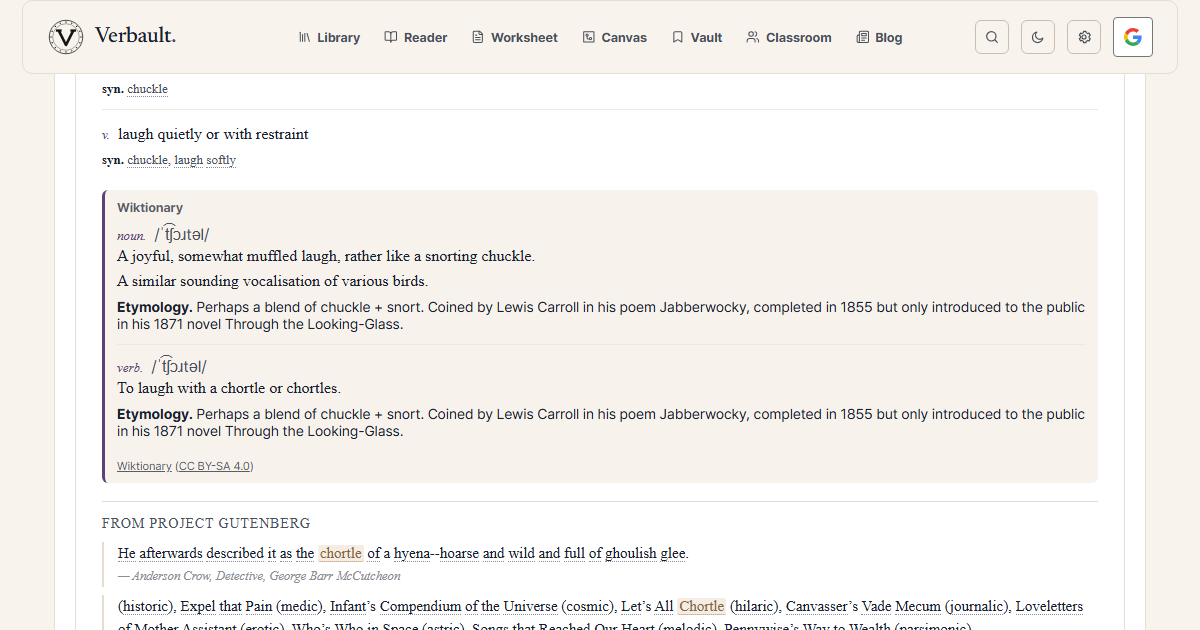
The dictionary is careful not to over-claim, though, and that care is worth watching. Galumph, the verb for moving heavily and clumsily, was also Carroll's, from the same poem — but it is filed not as a blend at all: the page calls it a back-formation from galumphing, the longer form he actually wrote. People like to say it fuses gallop and triumph, and maybe it echoes them, but the record stops short of saying so. That small gap is the whole discipline of the subject in miniature: a word can sound like a blend and have arrived some other way, and only the etymology, not the ear, can tell you which.
The blends you use without noticing
Carroll named the trick; English had always quietly done it, and has done it far more since — usually with no one deciding to. These are the blends so worn-in that you forget they were ever two words.
The dictionary writes each recipe out plainly. Smog is a "blend of smoke + fog," coined for the brown air that is both at once. Brunch is a "blend of breakfast + lunch," attested from 1895, for the meal that is neither and both. Motel is a "blend of motor + hotel," named after a single roadside inn in California in 1925. Electrocute is a "blend of electro- + execute." And guesstimate, a "blend of guess + estimate," is the word for a number honest enough to admit it is half of each.
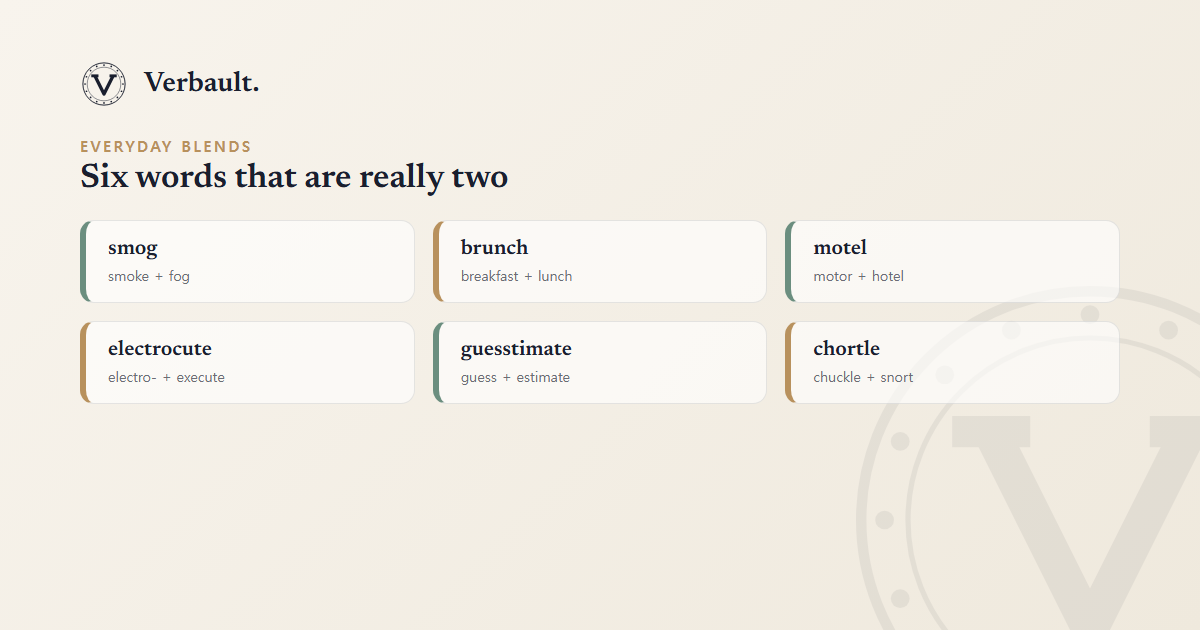
What they share is that two words were trimmed down and run together until they fit in one mouth. Precisely where the seam falls — how much of breakfast survives, how much of lunch — is the etymologist's quarrel, and dictionaries do not always agree on the cut. But the move is the same every time: take two words that already travel together, and fold them into one. It is the same honest gap between what the ear guesses and what the record proves that runs through the words English built straight out of noise.
A blend is not a compound
One line is worth drawing here, because it blurs easily. A compound sets two whole words side by side and keeps them both intact: handbook, nightfall, bookcase. Nothing is lost; the seam is simply the join between two undamaged pieces. A blend is the thriftier cousin: at least one of the two words is clipped, and the parts are spliced so the result comes out shorter than the sum. Breakfast and lunch run to fourteen letters together; brunch spends six. That trimming is the art of it.
Reading for the seams
Blends are one of the few corners of vocabulary you can enjoy without studying. The pleasure is in catching the join.
- When a word looks like two words fused, check its origin. Open its page — smog, chortle, any suspect — and read the etymology line. If it says blend of, you have caught one; if it sends you elsewhere, as galumph does, you have learned something better than a guess.
- Read Carroll where he did it. Open Through the Looking-Glass in the Reader, find Humpty Dumpty's little lecture, and tap a word to see how an invented blend behaves beside the real ones.
- Keep the good ones. Save a blend to your vocabulary list when it earns its place. They are among the easiest words to remember, because the meaning is sitting right there in the seam.
Carroll, characteristically, hid the joke inside the word he chose. He could have called it a blend, or a fusion, or a splice. Instead he reached for the suitcase — the bag that carries two things folded into one — and the name has been carrying its own two meanings around ever since.
Comments (0)
Log in to comment.