One Root, Ten Words: How Greek and Latin Roots Build English Vocabulary

A word you can half-read before you look it up
The first time you meet perspective on a page, you are not as stuck as you feel. Break the word apart and a familiar piece sits inside it: spec. If you know that this small Latin root means to look, you can already tell that a perspective is a way of looking at something — a point of view. The dictionary will fill in the rest, but you have met the word halfway.
That is the quiet usefulness of roots. English borrowed thousands of them from Latin and Greek, and they do not sit in one word each. A single root turns up across a whole family of words, and once you know it, every member of that family is part-decoded before you start.
One root, a family of words
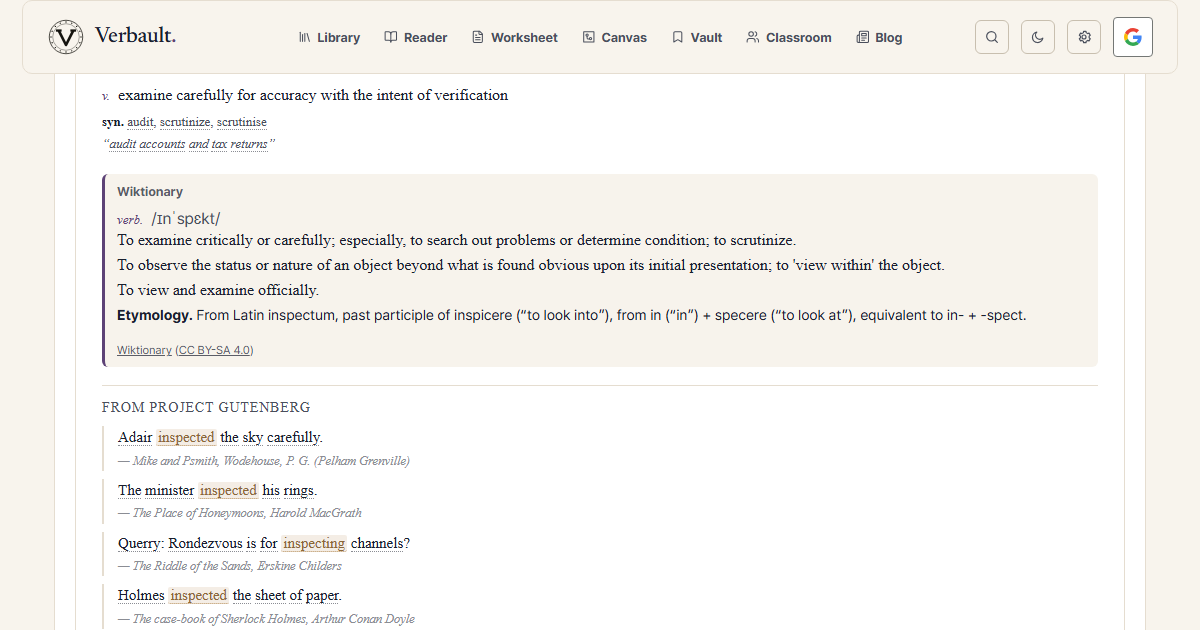
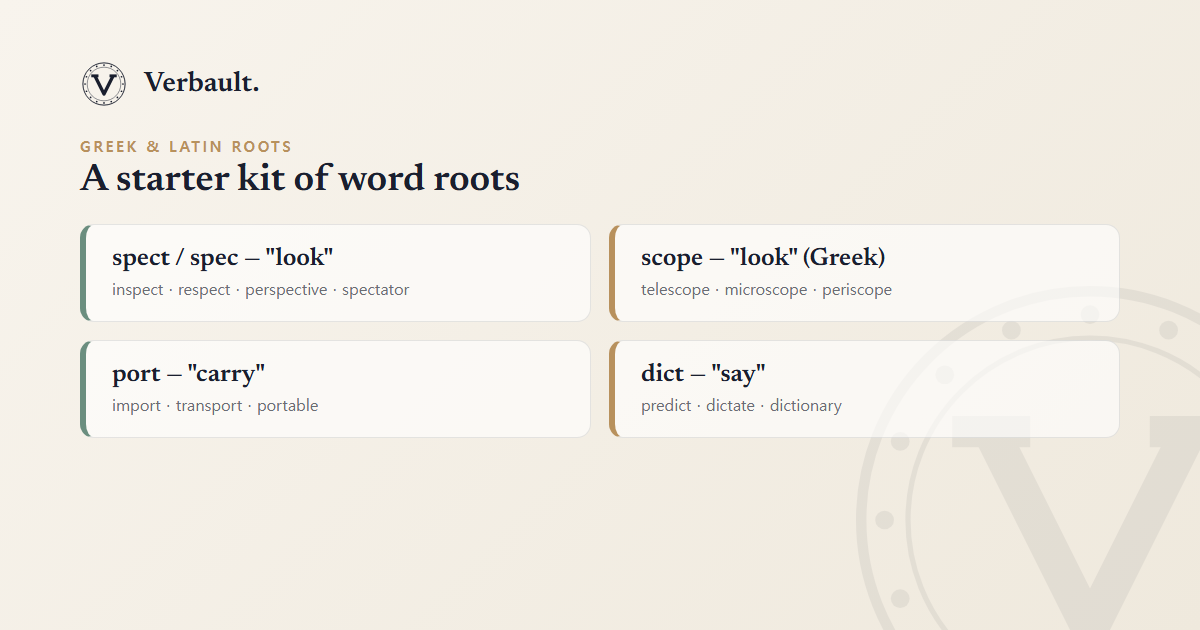
Take spect (also spelled spec), from the Latin verb for to look or to see. Open the word page for inspect and the origin is spelled out without fuss: it comes from in ("in") plus specere ("to look at") — to look into something. The root is sitting there in plain sight, and so is its meaning.
Now watch the same root do its work across an entire family:
- expect — to look out for what is coming (ex, "out")
- respect — to look back at someone, with regard (re, "back")
- suspect — to look at from under, with mistrust (sub, "under")
- prospect — to look forward (pro, "forward")
- inspect — to look into (in, "in")
- perspective — to look through; a point of view (per, "through")
- conspicuous — standing out, easy to look at (con, "together")
- spectator, spectacle, spectacular — one who looks, a thing looked at, a sight worth looking at
Ten words, one root. Each Verbault page records the same Latin root in its etymology line. The prefix changes the direction of the looking; the root keeps the looking itself constant.
The root runs through every level
Here is the part that pays off. Verbault tags each word with a rough difficulty, estimated from how common it is. (These are frequency estimates rather than official exam scores, but the spread is real.) On that scale, expect is one of the first words a learner ever meets and spectacular is one of the last. Same root, opposite ends of the difficulty range.
So the work is not ten separate jobs. You learn one root — spect, to look — and it quietly explains a word you already use, a word you are about to meet, and a word you will not need for years. That is the whole economy of roots: you pay once and collect for a long time.
The Greeks had their own word for looking
Latin is not the only lender. Greek gave English a second root for the very same idea: skopein, also to look at. You meet it whenever you name an instrument for looking. A telescope looks far (Greek tele, "afar"); a microscope looks at the small (micro). The word pages trace both straight back to the Greek verb. Once you hold the root, words like periscope (you look around a corner with it) and endoscope (a doctor looks inside you with it) stop being strange — the -scope tells you each one is an instrument for looking.
It is worth noticing what English did not borrow. The everyday verbs for looking — see, look, watch — are old Anglo-Saxon words; see goes back to Old English, not Latin. The classical roots arrived later, as a learned layer laid over the plain one. That is why the simple word is see and the formal one is inspect: the same act, two different histories.
Now try it yourself
The method is identical for any root. Two more worth carrying, and the word pages prove both.
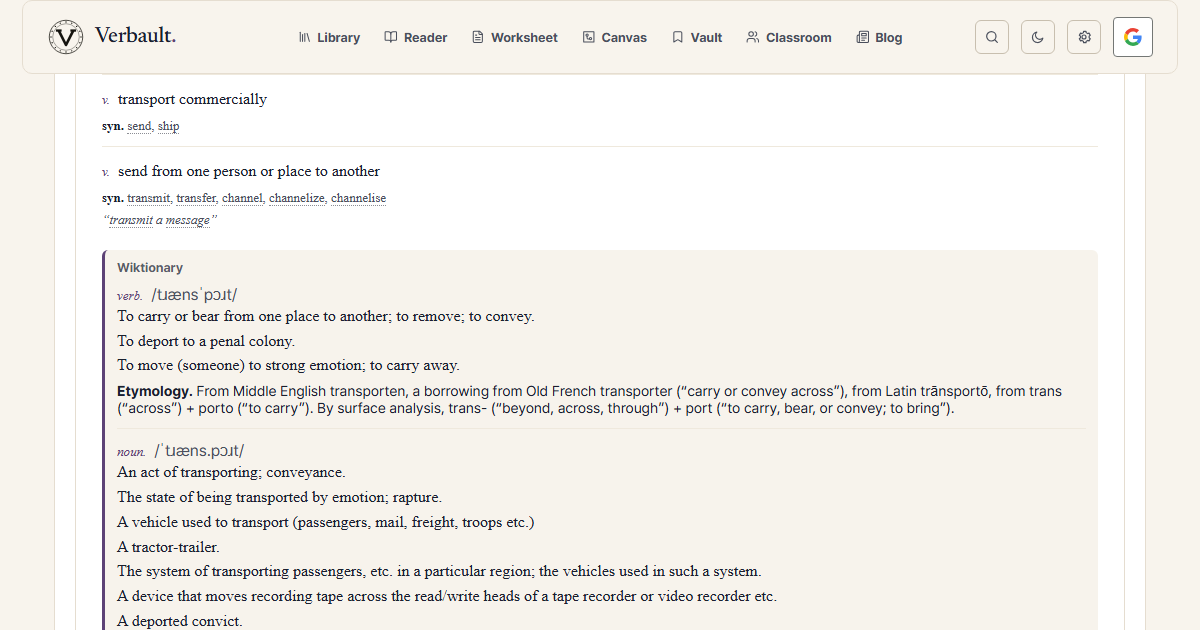
port, from the Latin for to carry. Import carries goods in; transport carries them across (trans); portable just means able to be carried. The root is the constant; the prefix sets the direction.
dict, from the Latin for to say. Predict is to say a thing before it happens (pre, "before"); contradict is to say against (contra); dictate is to say something aloud for another to write down; and a dictionary is, at root, a book of sayings — that is, of words.
When the root wears a disguise
Roots are not always so obvious, and it is worth being honest about that. The word verdict is a jury's spoken finding, and you might expect to see the dict root inside it. The Verbault page traces it instead to two old French words, veir ("true") and dit ("saying") — a true saying. The root is there, but in French dress: that dit is the same Latin dīcō, to say, that you met in predict and dictate. The page shows you the French; the step back to Latin is one I am drawing for you.
The lesson is a small caution. A root is a strong first guess, not a guarantee. Most of the time the piece you recognise really is the root and really does mean what you think. Now and then it has changed shape, or a look-alike turns out to be unrelated. The remedy is the same every time: read the etymology line and let the record settle it.
How to use roots while you read
You do not need a textbook of roots to begin. You need the habit of looking for them.
- When a long word stops you, look for a piece you know before you reach for the dictionary. A prefix and a familiar root will often carry you most of the way to the meaning on their own.
- Then check the etymology to be sure. Open the word's page on Verbault — conspicuous, or whatever stopped you — and read the origin line. It names the root and what it once meant.
- Follow the family. Once you have spect, tap through to the next spect word. Each one is already half-learned, so a family costs far less than the sum of its parts.
- Save the root, not just the word. Keep one clear example in a vocabulary list — inspect for spect, import for port — and let it stand in for the whole family.
You can do all of this inside the Reader: open any book, tap a word for its meaning and reading level, and follow its origin from there.
We have written before about how a word's origin can help it stick in your memory. This is the companion idea, and a different one. There the point was that a vivid story helps you remember a single word. Here it is plainer arithmetic: learn one root and you can recognise a whole family of words you never set out to memorise at all.
Comments (0)
Log in to comment.