Decoding the Color Symbolism in The Great Gatsby: What the Manuscript and Discarded Titles Reveal
The colors he almost called it
Before The Great Gatsby was The Great Gatsby, it was nearly half a dozen other things. Fitzgerald tried titles on his publisher like coats: Trimalchio, after the vulgar party-throwing freedman in Petronius; Gold-Hatted Gatsby; Among Ash-Heaps and Millionaires; Under the Red, White, and Blue. He was still wavering weeks before publication. Look at that list again and a pattern jumps out — almost every title he reached for was a color. Gold. Ash-grey. Red, white, and blue. The book we ended up with is named for a man, but the drafts belong to a writer thinking in pigment.
That instinct survived into the published text. Color in Gatsby is not decoration; it is how the novel keeps score. Once you start reading for it, the green, gold, white, grey, and blue stop being scenery and start telling you who is lying, who is dreaming, and who is already dead. Here is how the major colors work, and what the discarded titles and Fitzgerald's manuscript reveal about each.
A note on "the manuscript"
A quick caution, because the original manuscript gets thrown around loosely. Three different things survive: Fitzgerald's handwritten manuscript, which Matthew J. Bruccoli published in facsimile; the typed galley proofs he revised heavily, which James L. W. West III edited as Trimalchio: An Early Version; and the 1925 first edition. These are stages of one book, not rival versions: Fitzgerald cut and tightened all the way to print, and the papers themselves live at Princeton. They matter here for one reason: they show a writer who fussed over exactly these words, including, as we'll see, a single color-charged word on the last page that most editions still get wrong.
Green: the color that never made a title
Here is the strange part. Gold, ash, red-white-and-blue — Fitzgerald flirted with all of them on the title page. The one color he never tried is the one the book is actually about. Green.
Green is desire reaching across water. The first time we see Gatsby alone, he is staring at "a single green light, minute and far away" at the end of Daisy's dock — the whole distance between wanting something and having it, rendered as a color you can almost touch. By the last page that private green light has swelled into a continent's longing: the Dutch sailors who once found "a fresh, green breast of the new world," and Gatsby's faith in "the orgastic future that year by year recedes before us."
That last phrase is worth a pause. The copy in our library, like most paperbacks, prints orgiastic. Fitzgerald wrote orgastic. His friend and editor Edmund Wilson, preparing a posthumous edition in 1941, "corrected" it — and because most modern editions descend from Wilson's, the change stuck. Bruccoli later restored Fitzgerald's word from the manuscript. Orgastic is the stranger and better choice: not a wild party but a straining toward a peak that keeps receding. The manuscript, in other words, sharpens the book's last and greenest idea.

Gold and yellow: Gold-Hatted Gatsby
The discarded title Gold-Hatted Gatsby came straight from the epigraph Fitzgerald wrote for the book and signed with an invented poet's name — the epigraph Wilson, tellingly, later dropped:
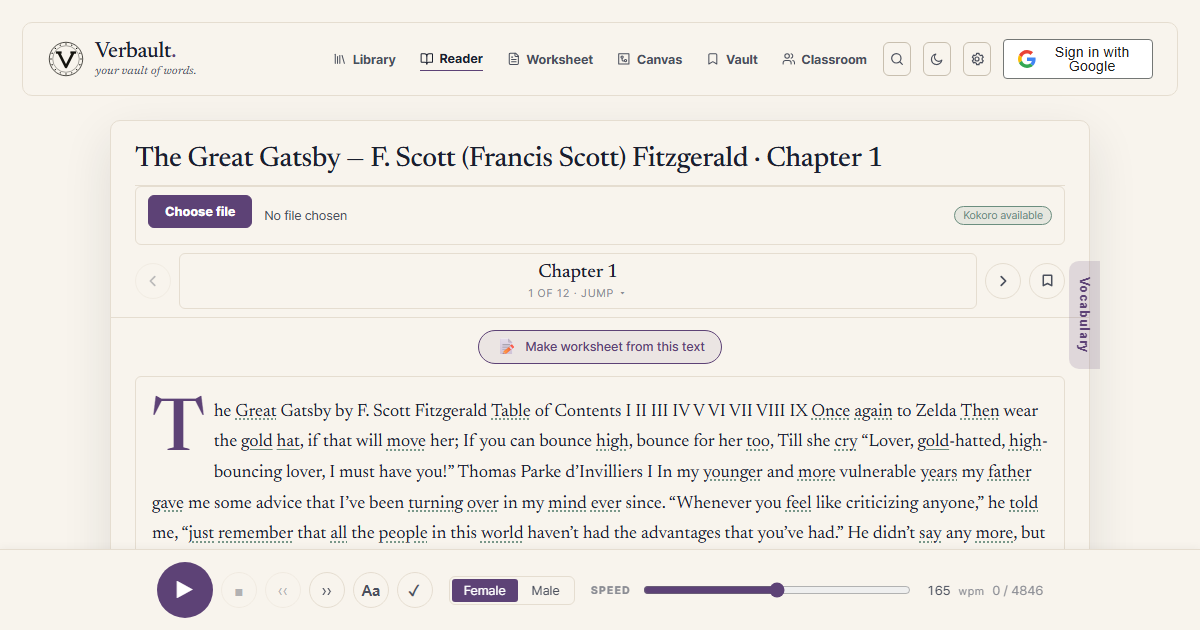
Then wear the gold hat, if that will move her; / If you can bounce high, bounce for her too, / Till she cry "Lover, gold-hatted, high-bouncing lover, / I must have you!"
Gold and yellow look like the same color and mean opposite things. Gold is the real article — old money, genuine value. Daisy is "the king's daughter, the golden girl," and her voice, Gatsby says suddenly, is "full of money." Yellow is gold's counterfeit, the gilt that fools you. The party guests dance to "yellow cocktail music"; "two girls in twin yellow dresses" drift through the crowd; the spectacles on the oculist's billboard are "enormous yellow"; and the car that kills is Gatsby's big yellow one. Read this way (and it is a reading, not a chemical fact), gold is value and yellow is the show of value, which is the whole tragedy of new money pressed into one pair of colors.
White: "Our beautiful white—"
White is the costume of innocence, worn over money. Daisy and Jordan are introduced "both in white," their dresses rippling as if just blown in; Daisy remembers their "white girlhood" and trails off — "Our beautiful white—" — as though the sentence itself can't finish the lie. The palaces of East Egg are white too. Nothing in this book that is white turns out to be clean: the color is what privilege wears so its hands look empty.
Grey: Among Ash-Heaps and Millionaires
One discarded title points straight at the novel's grey: Among Ash-Heaps and Millionaires. The ash-heap is the valley of ashes, the dead industrial stretch between the glittering Eggs and the city — "a fantastic farm where ashes grow like wheat into ridges and hills." Grey is what's left when the gold and white have been burned for someone else's party, and the Wilsons are the people who live in it. The title Fitzgerald threw away tells you he knew the grey was load-bearing: the millionaires are unthinkable without the ash-heap that pays for them.
Blue: Under the Red, White, and Blue
His last-minute choice (Fitzgerald cabled to ask for it too late to change the plates) was Under the Red, White, and Blue, which would have hung the American flag over the whole story. The blue stayed in the text as the color of watching and illusion. The faded eyes of Doctor T. J. Eckleburg, "blue and gigantic," stare out over the ashes like a god who has stopped paying attention. Gatsby throws his parties in "blue gardens." Blue is the dream's own color: vast, hazy, presiding over everything and saving no one.
How to read a novel by its colors
You don't need a scholar's apparatus to read this way. You need to notice color words as they pass and stop on the ones that keep coming back. The Verbault Reader is built for exactly that kind of slow attention, and following one color through a whole book is an unusually satisfying way to use it.
- Open the book. Start The Great Gatsby in the Reader. The full text loads chapter by chapter, with every word tappable.
- Tap a color word in its sentence. When you reach a yellow or a green, tap it. A small card shows the word's meaning, how common it is, and a button to hear the sentence read aloud — all without throwing you out of the page.
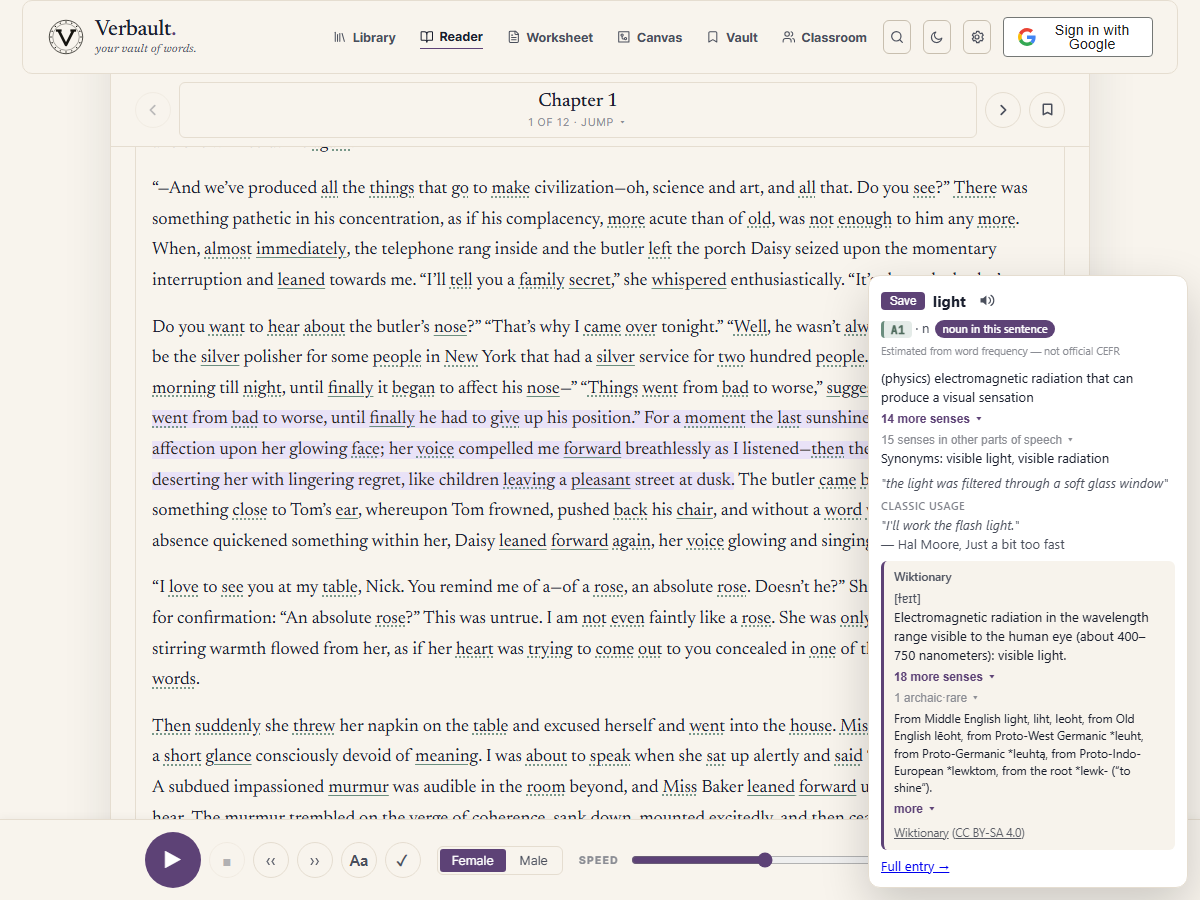
- Open the word's own page. Tap through to a page like green to see the word's full range of senses and a map of related words — handy when a color is doing more than one job at once, as green is.
- Keep the passages. Save the sentences where a color lands hardest. Our guide to learning vocabulary from classic books covers the saving-and-returning habit; the same loop works for images and motifs, not just single words.
Do that for one color — follow every green from the dock in chapter one to the last sentence — and the novel quietly reorganizes itself around it.
What the drafts leave us
Fitzgerald spent months choosing among colors for the cover and then named the book for a man. But the colors he set aside didn't leave; they went inside, where they do more work than any title could. The green he never put on the jacket turned out to be the color the final sentence is built from. Read with the palette in view and Gatsby stops being a story you remember and becomes one you can see.
Comments (0)
Log in to comment.