Dish and Desk: The Secret Twins Hiding in Everyday English
Two words that used to be one
English is full of pairs that look unrelated and turn out to be the same word wearing two coats. Linguists call them doublets: two words that reached English from a single ancestor by different routes — one borrowed early and worn smooth, the other borrowed later and closer to the original. Once both are in the language, they drift apart in meaning until nobody notices the family resemblance.
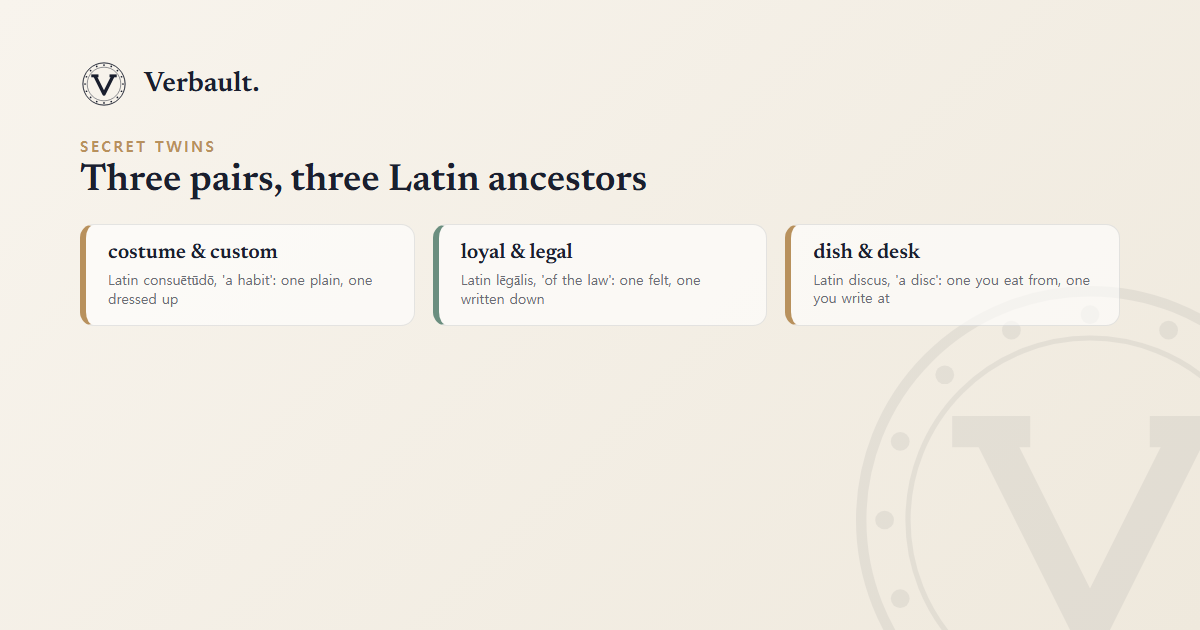
Here are three pairs of everyday words that each go back to one Latin ancestor. Not one of them looks like a relative of its twin, and each Verbault word page prints the origin line, so you can check the claim for yourself.
Costume and custom: one habit, two lives
Custom and costume both come from Latin consuētūdō, "a custom, a habit." Custom took the short road: it came through Anglo-Norman French into Middle English and kept the plain meaning — a habit, a usual practice, the way a thing is normally done.
Costume took the scenic route. It travelled through Italian, where costume meant not just habit in the abstract but the way people habitually dressed, the manner of a time and place. English borrowed that later sense, and it hardened into what we mean now: a costume is what you put on to look like someone else. One word for a habit of behaviour, one for a habit of dress, from a single Latin root.
Loyal and legal: keeping the law, keeping faith
Legal and loyal both descend from Latin lēgālis, "of the law," from lēx, "law." Legal is the bookish one — a learned borrowing that stayed close to the Latin in shape and in sense. If it has to do with the law, it is legal.
Loyal is the same word after a few centuries of wear in Old French, where lēgālis softened into loial. Its meaning shifted with its shape: from keeping to the law to keeping faith with a person or a cause. A loyal friend and a legal contract are, at root, both about holding to what binds you — one to the law of the land, the other to a bond of trust.
Dish and desk: the same flat disc
Now the strangest pair. Dish and desk share an ancestor you would never guess: Latin discus, "a disc, a platter." A discus was a round, flat thing, and both English words kept a piece of that flatness.
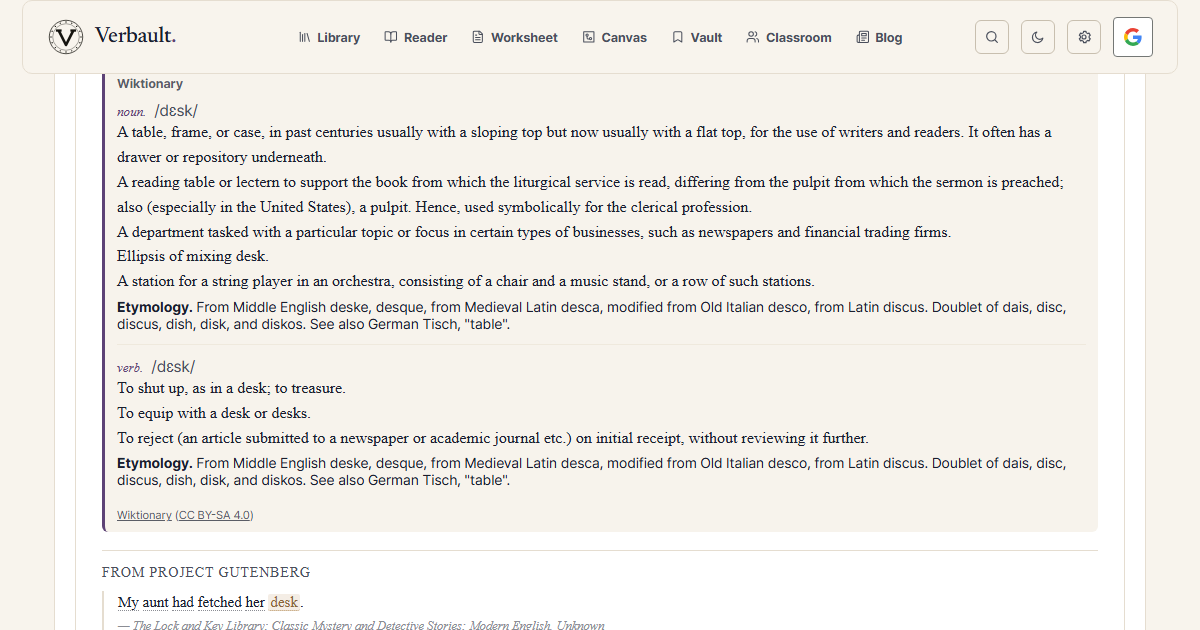
Dish is the older borrowing, taken into Old English so long ago that it looks thoroughly native. It held on to the platter sense: a flat vessel you serve food on. Desk arrived much later, through Medieval Latin desca and Italian desco, where the flat disc had become a flat table — a board to write on. Same round Latin plate; one branch became the thing you eat from, the other the thing you work at.
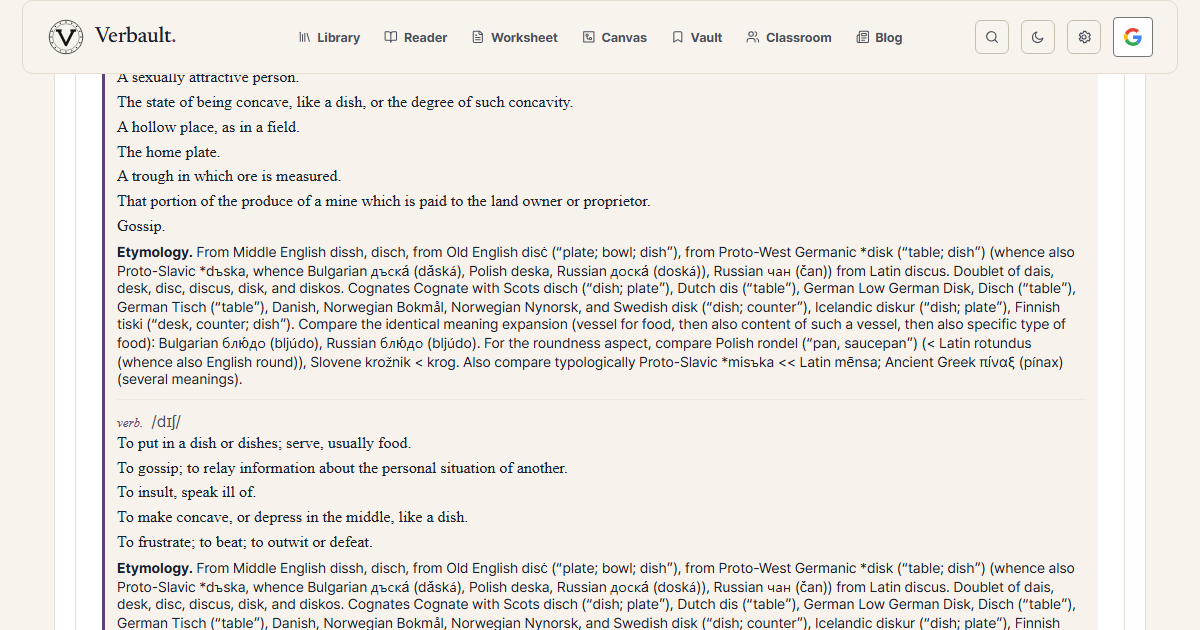
The word pages make the link plain. Dish traces to discus and names desk among its doublets; desk traces back through desca to the very same discus.
How to spot a doublet
There is a shape to how doublets form. A word enters English once; then, centuries later, the same Latin ancestor is borrowed again by a different route. Because the two arrivals are separated by time and language, they drift apart in form and in meaning. Legal and loyal are the clearest case: legal came straight from written Latin and stayed literal, while loyal came worn down through French and turned personal. The other pairs follow the same logic — an earlier, homelier word beside a later or more formal one, both grown from a root you can only see in the origin line.
Seeing them as you read
You can catch doublets in the wild. Open a chapter in the Reader and tap a word: the meaning that fits the sentence comes up first, and its origin sits one tap below. When two words go back to the same Latin root, their origin lines will say so — and a pair you had never connected clicks into place.
Comments (0)
Log in to comment.